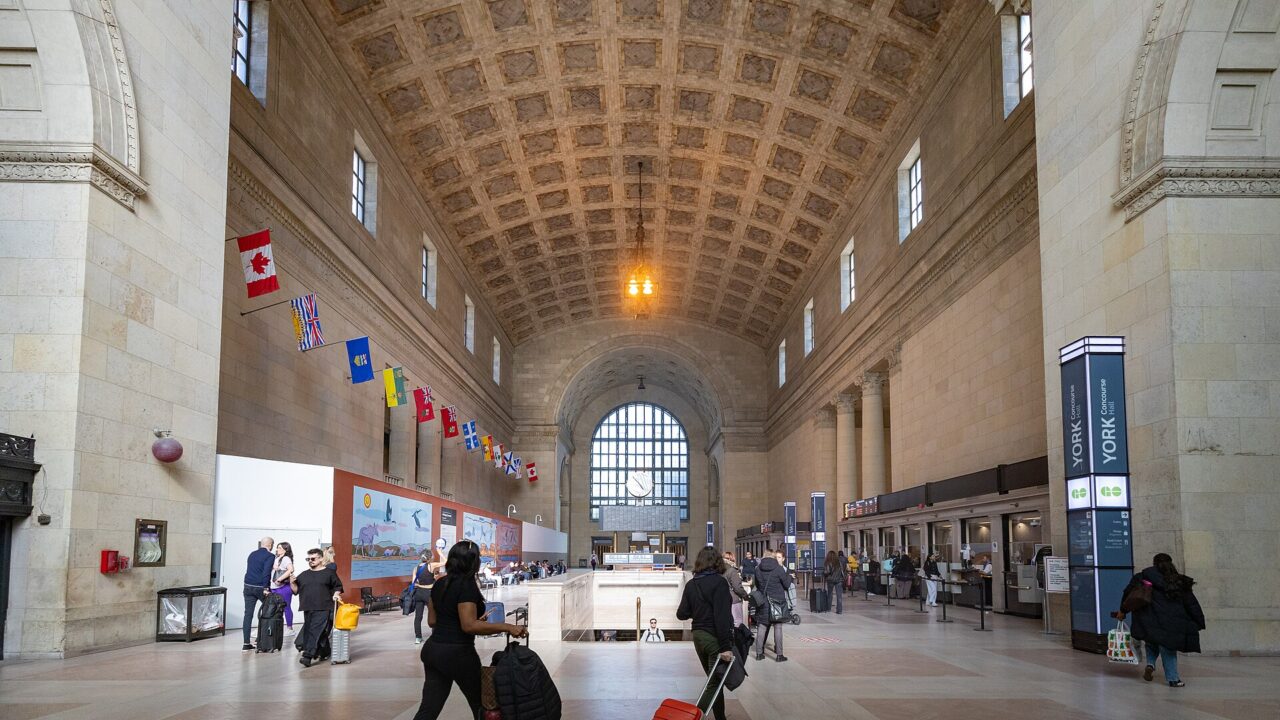
Come up the stairs from the subway at rush hour and the Great Hall does something no other room in this city does: it makes you stop. Twenty metres of coffered stone vault, a row of arched windows the height of a house, provincial flags hanging in a line, and the names of Canadian towns carved into the frieze running round all four walls — Halifax, Winnipeg, Medicine Hat, Prince Rupert — a list of everywhere the trains once went. Then somebody with a roller case walks into the back of you and you remember that Union Station Toronto is not a monument but a working building, and that three hundred thousand people come through it every day.
This guide explains what the station actually is, how to navigate it without the twenty minutes of confused circling that catches most first-timers, which services leave from where, where to eat, the honest answer on luggage storage, and what is worth seeing in the ten minutes you might have spare. Details were checked in September 2026 and prices are in Canadian dollars.
At a Glance
| Detail | What to know |
|---|---|
| Address | 65 Front Street West, at Bay Street |
| Opening hours | Daily 5:30am to 12:45am; shop hours vary |
| Daily footfall | Around 300,000 |
| Services | GO Transit, VIA Rail, UP Express, TTC subway and streetcars |
| Airport link | UP Express to Pearson Terminal 1, about 25 minutes |
| Retail | Around 30 shops plus Union Market and a food court |
| Luggage storage | None run by the station — see below |
| Connected to | The PATH network, the Fairmont Royal York, Scotiabank Arena |
| Time to allow | 20 minutes if you are changing services and don’t know it |
What Union Station Actually Is
Union Station is the busiest passenger transport facility in Canada and, by most measures, the busiest building of any kind in the country. It opened in 1927 — the Prince of Wales did the honours — although trains did not fully move in until 1930, and the delay was the result of one of those long municipal arguments about railway viaducts that Toronto specialises in.
Architecturally it is Beaux-Arts: a long colonnade of twenty-two limestone columns facing Front Street, and behind it the Great Hall, a barrel-vaulted room the length of a city block. It is a National Historic Site, which is why the stonework has survived a century of a city that demolished most of its equivalents.
The building you walk through today is largely the product of a very long revitalisation programme that ran through the 2010s and into the 2020s. It excavated an entire new level beneath the station, restored the Great Hall, rebuilt the two concourses, and added roughly 170,000 square feet of new space with about thirty retailers in it. The result is a station that finally works as a building — and one where a lot of published directions are out of date, because whole passageways moved.
A century of arguments
The short history is worth knowing because it explains the building’s oddities. Toronto’s previous Union Station burned in the Great Fire of 1904 along with a large part of the surrounding district, and the replacement was designed almost immediately. Construction began in 1914, was interrupted by the First World War, and the finished building sat essentially complete for years while the railways, the city and the federal government argued about the viaduct that would carry the tracks — an argument that delayed full operations until 1930.
It was very nearly lost. Through the 1960s and 1970s there were serious proposals to demolish the station as part of a redevelopment of the rail lands, at exactly the period when Toronto was tearing down almost everything else of that vintage. Public opposition saved it, it was designated a National Historic Site in 1975, and the city bought it outright in 2000. Every visitor who stands in the Great Hall is standing in a room that was scheduled for the wrecking ball within living memory.
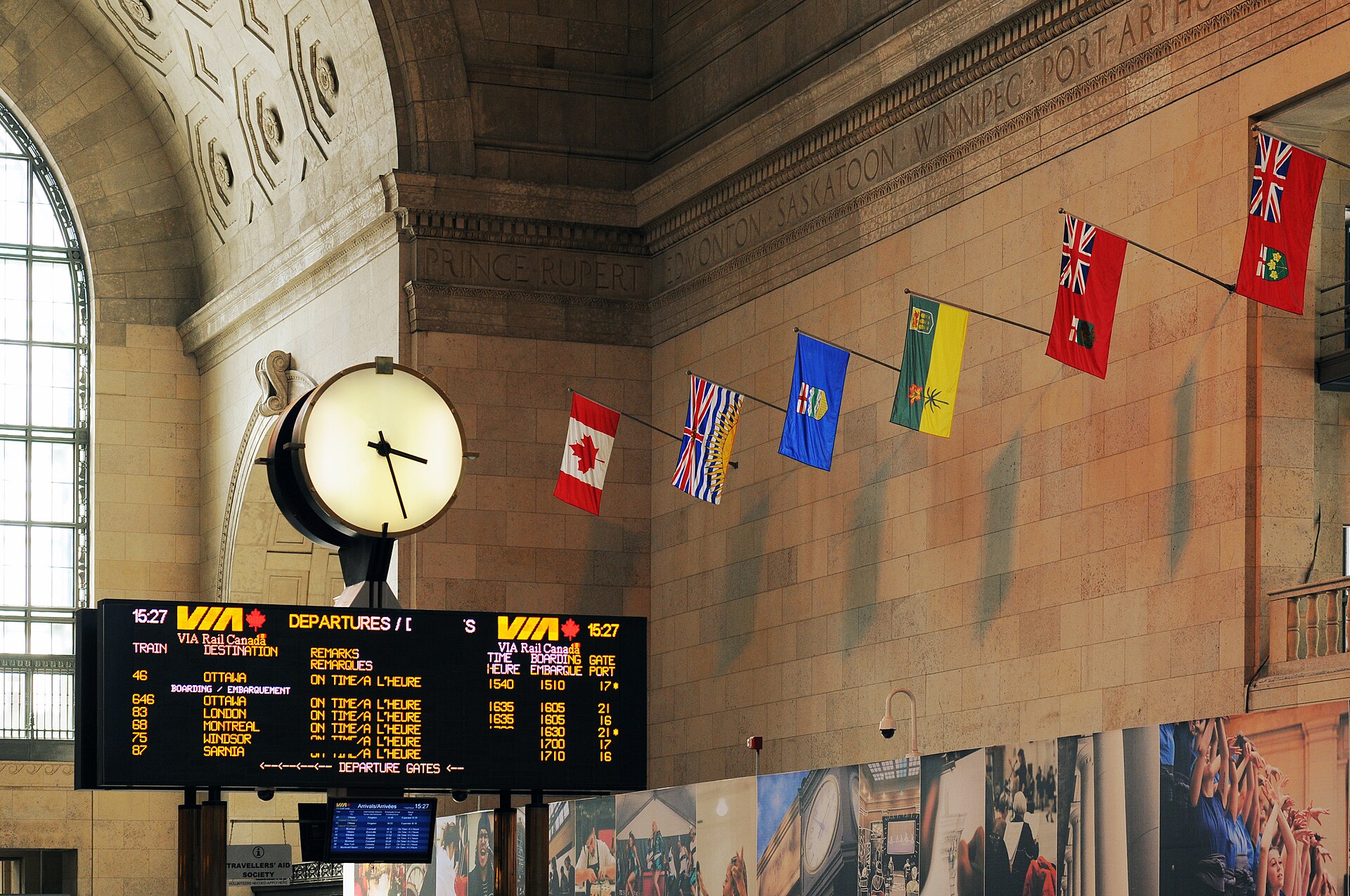
That near-miss also explains why the frieze matters. The place names carved into the stone — Prince Rupert, Medicine Hat, Saskatoon, Port Arthur — are a snapshot of a national rail network that has since shrunk enormously. Half those destinations no longer have a passenger service from here at all.
Where the Trains Actually Go
Four operators use the station and they do completely different jobs. Knowing which one you want is most of the battle.
GO Transit — the regional network
The green trains, and the ones most visitors will use. Seven lines radiate from Union across the Greater Toronto and Hamilton Area, and the two that matter to a tourist are Lakeshore West — which runs to Exhibition (one stop, for BMO Field), Port Credit, Oakville, Burlington, Hamilton and on to Niagara Falls — and Lakeshore East, which runs out past the Beaches to Guildwood, useful for the Scarborough Bluffs, and on toward Oshawa. Fares are distance-based and PRESTO or a contactless card is the easy way to pay.
VIA Rail — intercity
The national passenger operator. The workhorse is the Corridor service to Ottawa (about four and a half hours) and Montreal (about five), which is genuinely a pleasant alternative to flying, plus services west to London and Windsor and east to Kingston. From here you can also board The Canadian, the sleeper train to Vancouver, which takes four nights and is one of the great rail journeys anywhere. Book VIA well ahead; walk-up fares are punishing.
UP Express — the airport
Dedicated service to Pearson Terminal 1 from its own platform at the western end, roughly every fifteen minutes, about 25 minutes end to end, with stops at Bloor and Weston. It is the reason many visitors set foot in Union at all.
TTC — the city
Union subway station on Line 1 and the streetcar loop beneath the building. This is how you get anywhere in Toronto itself, and it is a two-minute walk from the concourse. Our getting around Toronto guide puts all four networks in one picture.
How to Navigate It
Union confuses people because it is organised vertically as well as horizontally, and because the signs assume you know which service you are looking for. Here is the mental model that makes it simple.
Three levels
- Street level — the Great Hall, the Front Street entrance and the VIA Rail ticket counters.
- The concourse level below — where you actually catch trains. This is where the two big concourses are, and where the food is.
- The train shed above — the platforms, reached by escalators up from the concourses.
Counterintuitively, you go down to the concourse and then up to the platforms. Almost everybody gets this wrong once.
Two concourses, and which one you want
- The York Concourse is at the west end, toward the CN Tower and the Scotiabank Arena. Bright, modern, glass-roofed, and the more pleasant of the two.
- The Bay Concourse is at the east end, toward Bay Street and the Royal York.
Both serve GO trains and both connect to the platforms above; the platform stairs you want depend on which track your train is on, and track assignments are only posted shortly before departure. The practical rule: get to the concourse level, look at the departure boards, and do not commit to a set of stairs until your track is called.
The four services and their homes
| Service | Where | Goes to |
|---|---|---|
| GO Transit trains | Both concourses, platforms above | Across the Greater Toronto and Hamilton Area, plus Niagara Falls |
| VIA Rail | Ticket counters in the Great Hall, departures via the concourse | Ottawa, Montreal, Windsor, Vancouver |
| UP Express | Its own platform at the west end, via the SkyWalk | Pearson Terminal 1 in about 25 minutes |
| TTC subway | Union station, below the concourse | Line 1, in both directions |
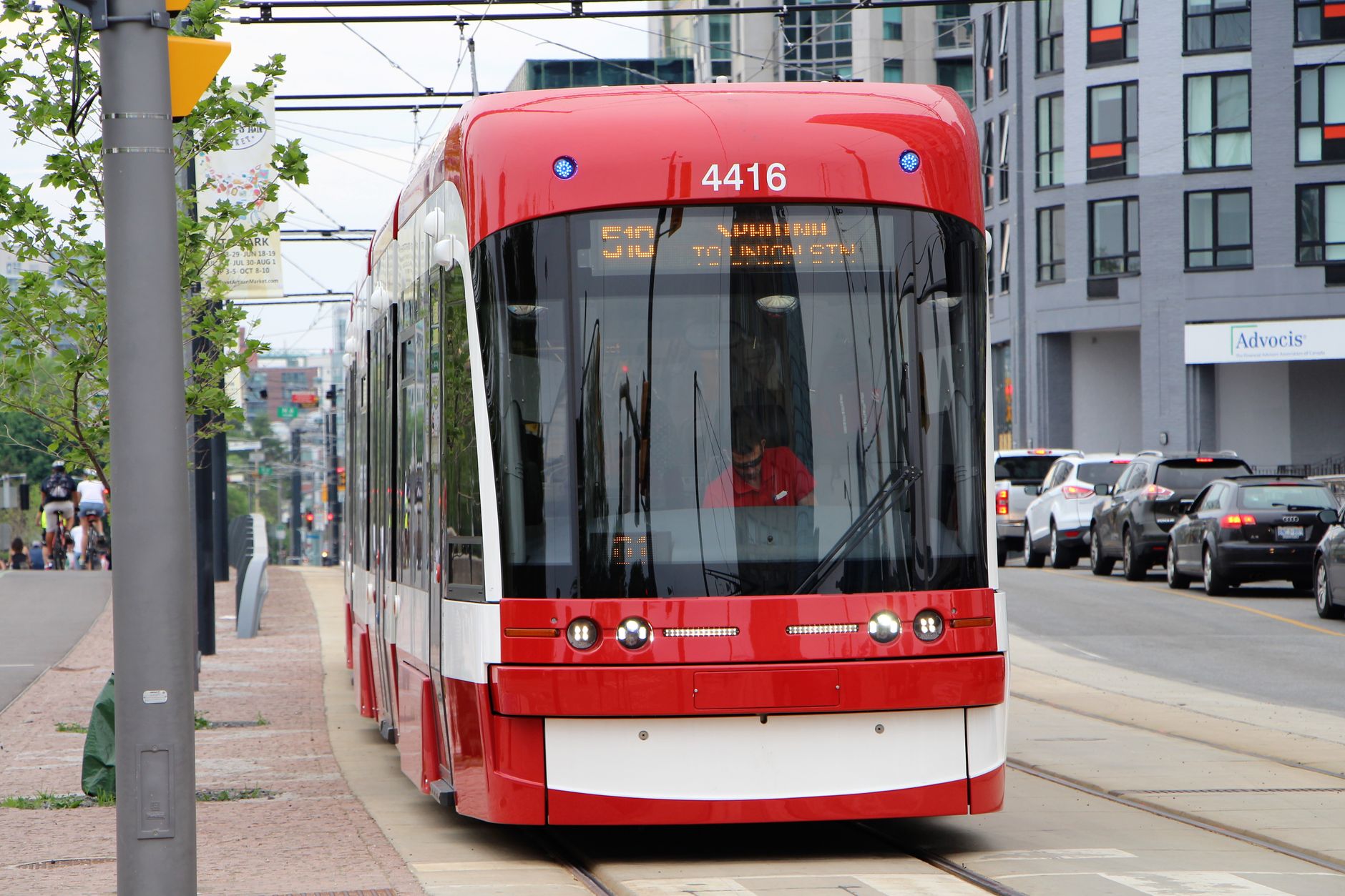
| TTC streetcars | Union Loop, below street level | 509 Harbourfront and 510 Spadina |
| GO buses | Union Station Bus Terminal, east on Bay Street | Regional destinations |
The single most common navigation error is looking for UP Express in the main concourse. It has its own platform reached along the SkyWalk at the western end — follow the UP signage rather than the general train signage, and allow ten minutes from the Great Hall. Our UP Express guide covers the service and airport to downtown compares it against the alternatives.
The TTC connection
Union is a Line 1 subway station, sitting at the bottom of the U where the two legs of the line meet. Trains leave in both directions and both end up going north, which trips up visitors constantly — check the destination on the front of the train (Finch for the Yonge leg, Vaughan for the University leg) rather than assuming.
The streetcar loop is below street level too, with the 509 running along Queens Quay to Exhibition and the 510 running north up Spadina. Both are useful and both are easy to miss. Tap a contactless card or PRESTO; a single fare is $3.30 and buys two hours of travel. See our PRESTO guide and the TTC guide.
Food and Drink
Union Station’s food went from genuinely bad to genuinely good over the course of the revitalisation, and it is now a reasonable place to eat rather than merely somewhere to buy a sandwich under duress.
- Union Market — a food hall on the lower level with independent vendors alongside the chains. The best of what is here, and the place to eat if you have half an hour.
- The food court — quicker, cheaper and exactly what you expect.
- Sit-down restaurants and bars — several around the concourses, useful for killing an hour before a train and priced for a captive audience.
- Coffee — multiple options, all with a queue at 8am.
The honest note: it is station food at station prices. If you have an hour and the weather is reasonable, St. Lawrence Market is a twelve-minute walk east and is a much better lunch. Our Toronto food guide has the wider picture.
Luggage Storage: The Honest Answer
This is the question the station gets asked most and answers least clearly, so plainly: Union Station does not operate lockers or a left-luggage office for general passengers. There is no coin locker bank to find, and looking for one will cost you half an hour.
What exists instead is a network of third-party luggage storage operators — LuggageHero, BagsAway, Stasher, Radical Storage and others — who partner with shops, cafés and hotels within a few minutes’ walk of the station. You book online, get a confirmation, and drop your bag at the partner location. Expect roughly $1.50 an hour or somewhere between $8 and $10 a day per bag, with insurance usually included.
Two alternatives worth knowing. If you are travelling with VIA Rail on a route that offers checked baggage, that is handled at the station itself for ticketed passengers. And most downtown hotels will hold luggage for guests on a departure day at no charge, which covers the common case of an eleven o’clock checkout and an evening flight — see best hotels in downtown Toronto.
Getting To and From Union
- From Pearson airport: UP Express, 25 minutes, straight into the station.
- From anywhere on Line 1: the subway ends up here whichever leg you are on.
- From the waterfront: the 509 and 510 streetcars terminate underneath.
- On foot: the PATH connects Union to the whole Financial District underground, which in February is the difference between a pleasant walk and a miserable one. Our PATH guide maps it.
- By taxi or rideshare: the Front Street frontage is chaotic at peak times. The pickup points move with construction; check your app’s designated spot rather than standing where it looks obvious.
What Is Within Ten Minutes
Union sits at the exact centre of visitor Toronto, which is the most useful thing about it. On foot from the Front Street doors:
- The Fairmont Royal York — directly across Front Street, connected underground, and worth walking through the lobby even if you are not staying.
- Scotiabank Arena — four minutes south-west, connected by an indoor walkway. See the arena guide.
- The CN Tower and Rogers Centre — about ten minutes west along the SkyWalk, entirely indoors. See the CN Tower guide and the Rogers Centre guide.
- The Hockey Hall of Fame — six minutes east at Yonge and Front, in a magnificent old bank building.
- St. Lawrence Market — twelve minutes east.
- The waterfront and the ferry docks — eight minutes south, under the Gardiner. Our waterfront guide covers what is down there, including the harbour cruises.
That density is why so many visitors choose to stay within a few blocks of the station — see where to stay in Toronto for whether that is the right call for your trip.
The Building Itself: What to Look At
If you have fifteen minutes rather than five, these are the things worth finding. None of them are signposted as attractions, which is part of the charm.
- The frieze. Run your eye round the top of the Great Hall walls. The carved place names read as a list of a country that used to be connected by rail: Halifax, Prince Rupert, Medicine Hat, Port Arthur — the last of which no longer exists under that name, having been amalgamated into Thunder Bay in 1970.
- The ceiling. Guastavino tile, laid in a herringbone pattern in a self-supporting vault. The same system holds up Grand Central’s oyster bar and a good deal of early-twentieth-century New York. Look for the subtle colour variation across the tiles.
- The colonnade on Front Street. Twenty-two limestone columns, best seen from the far side of the road rather than from underneath. Early evening light is kind to it.
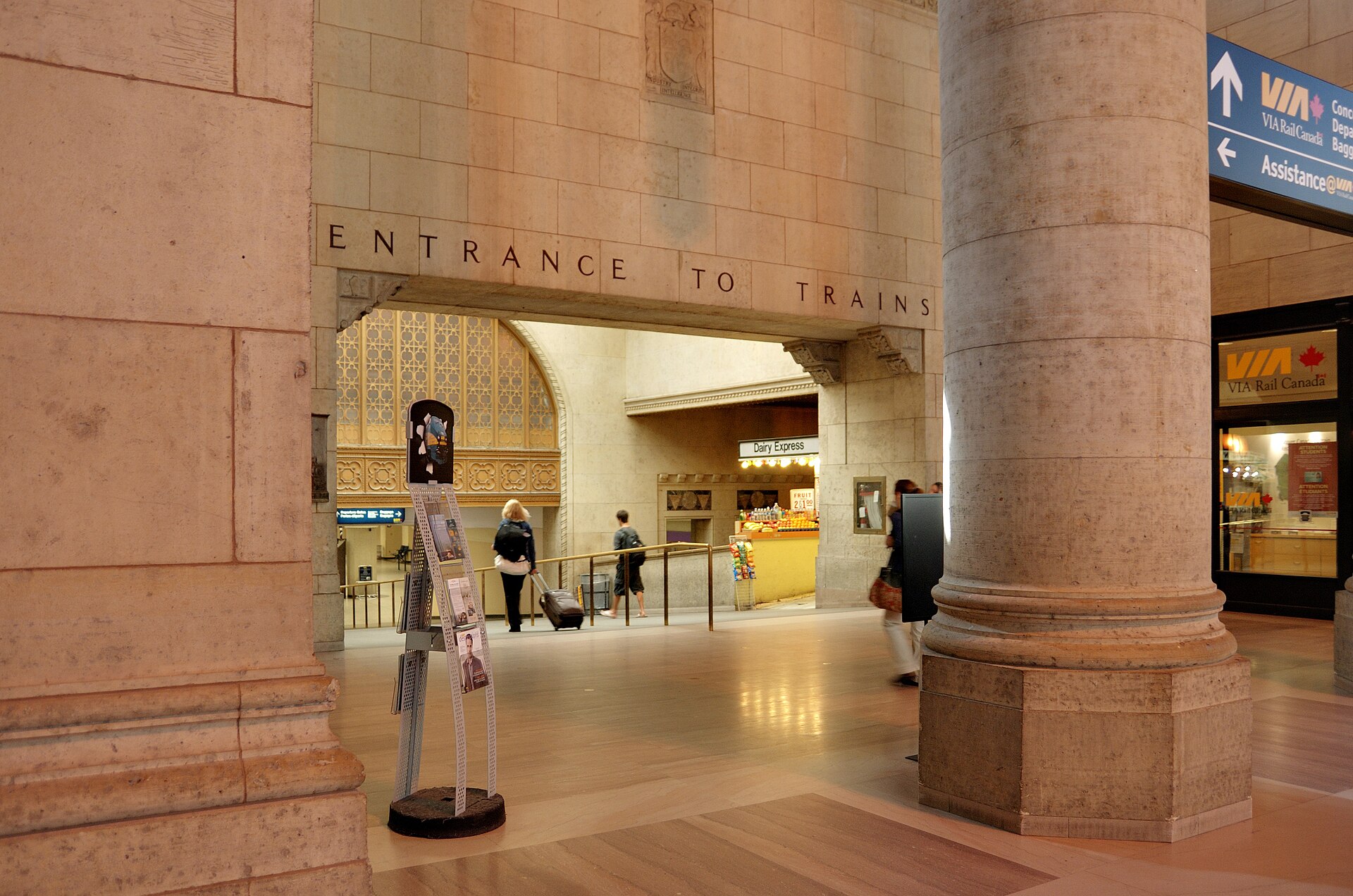
- The inscriptions over the doorways. “Entrance to Trains” and its companions are carved into the stone in a serif that predates every wayfinding consultant who has since been paid to improve the signage.
- The Royal York across the street. Built by the railway in 1929, and for a while the tallest building in the British Empire. Walk through the lobby — nobody will stop you — and look at the ceiling in there too.
- The York Concourse roof. The modern half of the station is worth a look on its own terms: a long glass and steel canopy that floods a below-ground space with daylight, which is a harder trick than it sounds.
Union also turns up constantly on screen, standing in for grander American stations in films shot in Toronto — a role the city plays so often that locals have stopped noticing. Our Toronto filming locations guide covers the rest.
Timing Your Visit
| When | What it’s like |
|---|---|
| Weekday 7:30–9:30am | Peak commuter crush; avoid with luggage |
| Weekday 10am–3pm | Calm, easy, best time to photograph the Great Hall |
| Weekday 4:30–6:30pm | The worst of it, and the concourses genuinely fill |
| Weekend daytime | Relaxed, with reduced GO frequencies on some lines |
| Two hours before a game | Arena and ballpark crowds, so add ten minutes |
| After 11pm | Quiet, and the station shuts at 12:45am |
What Is Not Worth It
- Arriving five minutes before a GO train. Track assignments post late and the walk from the Great Hall to a far platform is longer than it looks. Fifteen minutes is the minimum.
- Eating a full meal in the station when you have an hour. St. Lawrence Market is twelve minutes away and considerably better.
- Looking for lockers. There aren’t any. Book a third-party storage spot before you arrive.
- Taking a taxi to anywhere on Line 1. The subway is directly below you and the traffic on Front Street is among the worst downtown.
- Assuming a printed map is current. Passageways have moved repeatedly through the revitalisation; trust the signage in front of you over anything you read beforehand.
- Trying to change between UP Express and a GO train in under ten minutes. They are at opposite ends of a very large building.
Practical Tips
- Allow twenty minutes the first time. After that it takes five.
- Learn the concourse names. York is west, Bay is east. Half the signage assumes you already know.
- Departure boards are the authority. Track numbers change, and they change late.
- The station closes overnight, from 12:45am to 5:30am. It is not somewhere to spend a night between flights.
- Accessibility is good but not uniform. Lifts exist to every concourse and platform, and the newer York Concourse is the easier of the two. Allow extra time.
- Washrooms are on the concourse level and are busy at every peak.
- The Great Hall is worth five minutes. Stand at the west end, look east along the vault, and read the carved place names. Most people walking through it have never once looked up.
- If you are heading to Niagara, GO trains leave from here — see our Niagara Falls day trip and day trips guides.
Frequently Asked Questions
What time does Union Station Toronto open?
The station is open daily from 5:30am to 12:45am. Individual shops and restaurants keep their own hours, most of them shorter.
Is there luggage storage at Union Station?
Not run by the station. There are no public lockers. Third-party operators such as LuggageHero, BagsAway and Stasher store bags at partner shops and hotels within a short walk, typically around $1.50 an hour or $8–$10 a day. Downtown hotels will usually hold bags for their own guests free of charge.
How do you get from Union Station to Pearson airport?
The UP Express runs from a dedicated platform at the western end of the station to Pearson Terminal 1 in about 25 minutes. Follow the UP signage specifically — it is not in the main train concourse, and the walk takes about ten minutes from the Great Hall.
Which concourse do I need?
York Concourse is at the west end toward the CN Tower; Bay Concourse is at the east end toward Bay Street. Both serve GO trains and both connect up to the platforms. Check the departure board for your track before choosing your stairs.
Is Union Station worth visiting if you’re not catching a train?
The Great Hall is genuinely worth five minutes for its scale and the carved destination frieze, and Union Market is a decent lunch. It is not a destination in itself, but you will almost certainly pass through it, and it takes very little effort to look up while you do.
How busy does it get?
Around 300,000 people a day. Weekday mornings between 7:30 and 9:30 and evenings between 4:30 and 6:30 are the crush; weekends are calm by comparison, other than a couple of hours before a big event at the arena or ballpark.
Is Union Station connected to the PATH?
Yes, and it is one of the network’s main anchors. From the station you can reach most of the Financial District, the Eaton Centre and several hotels without going outside.
Can you get to the Toronto Islands from Union Station?
Not directly, but the ferry terminal is about an eight-minute walk south, under the Gardiner Expressway and across Queens Quay. Alternatively take the 509 streetcar from beneath the station.
Where do GO buses leave from?
From the Union Station Bus Terminal on Bay Street just east of the rail station — a separate building, connected but not the same place as the train concourses. Allow time if you are transferring.
How long should I allow to change trains?
Fifteen minutes between GO services if you know the station, twenty if you do not. Allow at least twenty minutes between UP Express and anything else, because they are at opposite ends of the building.
For a lot of visitors, the most useful train out of Union isn’t a GO train at all. VIA Rail runs around 40 departures a week to Montréal, with Economy fares from $78 one way, arriving at Gare Centrale in the middle of downtown around five hours later. Our Toronto to Montreal train guide covers fares, which side to sit on, and a two-day Montréal weekend without a car.
If your trip starts or ends with an early train, sleeping within a few minutes of the platforms takes most of the stress out of it. The Fairmont Royal York is linked to the station by a PATH tunnel, the Delta connects along the SkyWalk, and the old Strathcona on York Street has reopened as the budget-friendly Union Hotel. Our guide to hotels near Union Station Toronto compares them, with honest walking times.
Related Toronto Guides
- Getting Around Toronto — the pillar guide to every mode in the city.
- UP Express Guide — the airport train, its fares and where to find it.
- Toronto TTC Guide — subway, streetcars and how the fare system works.
- PRESTO Card Guide — whether you need one as a visitor.
- PATH Underground Guide — the thirty kilometres of tunnel that start here.
- Hotels Near the CN Tower — the ones within walking distance of the station.
- First Time in Toronto — thirty things to know before you arrive.
Photo Credits
The Great Hall: The Great Hall at Toronto Union Station, April 3 2026 by Dillan Payne, CC BY-SA 4.0, via Wikimedia Commons.
The carved destination frieze and departure board: Toronto ON Union-Station Great-Hall 2019-04-01 by Milan Suvajac, CC BY-SA 4.0, via Wikimedia Commons.
Entrance to trains: Toronto – ON – Union Station1 by Taxiarchos228, FAL, via Wikimedia Commons.