Ask ten Torontonians what their city’s signature food is and you will get a peameal bacon sandwich, a Jamaican patty, a long pause, a dim sum order, a heated argument about raisins in butter tarts, and at least one person insisting that the real answer is “everything, because half of us were born somewhere else”. They are all right. Toronto has no single dish in the way Montréal has bagels or Philadelphia has cheesesteaks. So what food is Toronto known for? A short list of genuine local classics with real history behind them — and then the far longer list of dishes that immigrant communities brought here and turned into something distinctly Torontonian.
This guide works through both: what each dish is, where it came from, where to eat a good one, and which “Canadian classics” you will see on tourist menus that do not actually belong to Toronto at all. Venues were checked in October 2026. Prices for individual sandwiches and pastries change often, so check with the vendor; most of what is on this list is cheap, counter-service food that costs well under a sit-down meal. Ontario’s HST is 13%, so check whether a menu price already includes tax or has it added at the till.
Toronto’s Classic Foods at a Glance
| Dish | What it is | Where to try it | Truly Toronto? |
|---|---|---|---|
| Peameal bacon sandwich | Cornmeal-crusted cured pork loin on a bun | Carousel Bakery, St Lawrence Market | Yes — the official signature dish |
| Jamaican beef patty | Flaky, turmeric-yellow pastry with spiced beef | Golden Patty, Kensington Market | Caribbean-born, Toronto-adopted |
| Butter tart | Small pastry with a runny sugar-butter-egg filling | Bakeries across the city, St Lawrence Market | Ontario through and through |
| Roti | Curry wrapped in a soft flatbread | West Indian roti shops | Caribbean-born, Toronto-adopted |
| Street meat | Grilled hot dog or sausage from a cart | Carts downtown, outside Nathan Phillips Square and the big venues | A Toronto ritual |
| Sushi pizza | Fried rice patty topped with raw fish and spicy mayo | Japanese restaurants across the city | A fixture of Japanese menus in the city |
| Dim sum and Hakka | Cantonese small plates; Indian-Chinese chili chicken | Chinatown, Scarborough, Markham | Widely available across the city |
| Poutine | Fries, cheese curds and gravy | Everywhere | No — it is from Québec |
The Peameal Bacon Sandwich
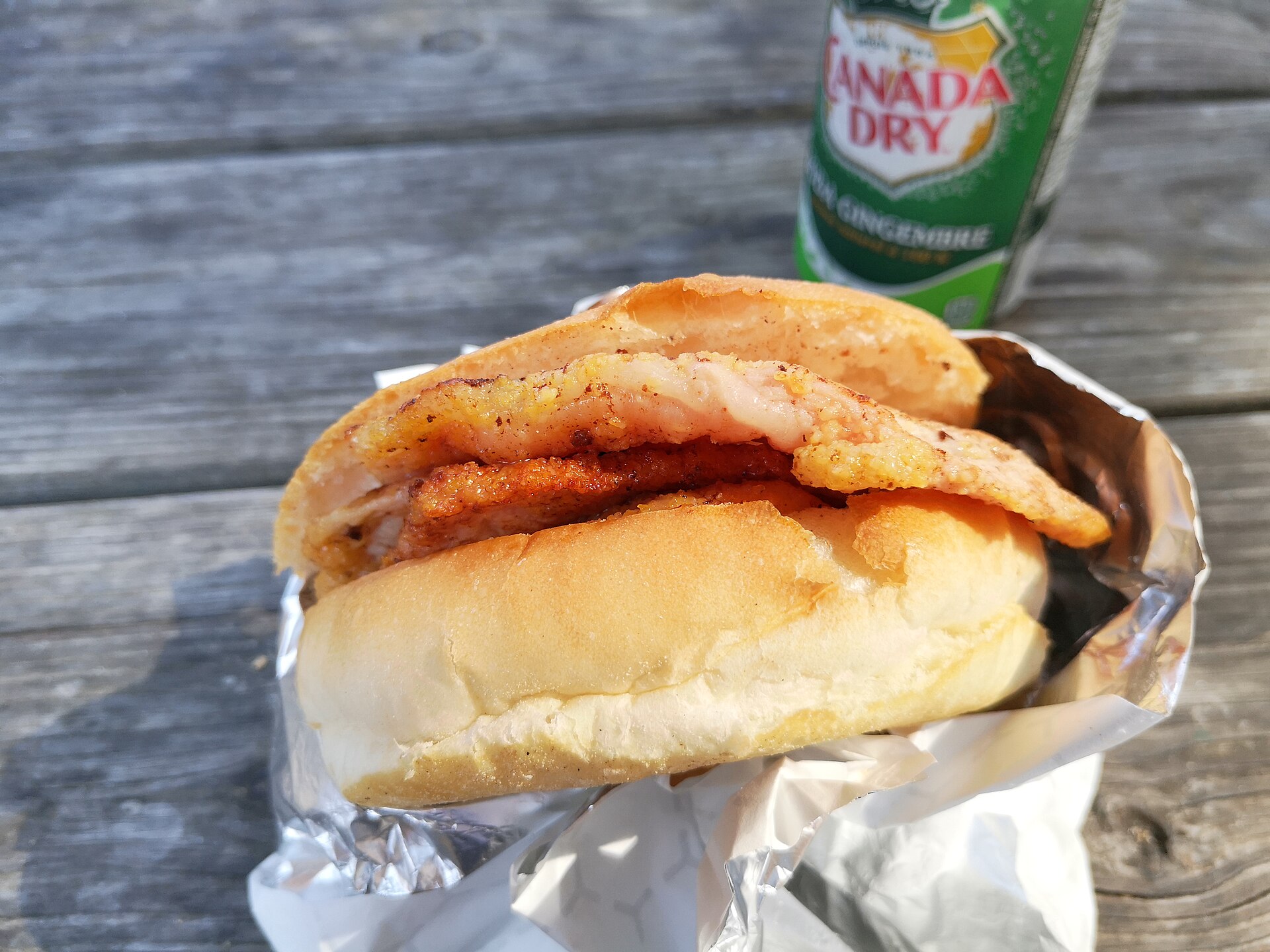
If Toronto has one dish, this is it. In 2016 the peameal bacon sandwich was officially declared the city’s signature dish, which settled an argument few people outside Toronto knew was happening.
What it is
Peameal bacon is not bacon as most people imagine it. It is a lean pork loin that is wet-cured — brined, not smoked — and then rolled in a coating. Originally that coating was ground yellow peas, which is where the name comes from; today it is cornmeal, which gives the meat its distinctive yellow crust. Sliced thick and griddled, it comes out juicy and slightly salty with a crisp, golden edge. Americans sometimes call its unrolled cousin “Canadian bacon”, but peameal is its own thing, and you will struggle to find it done properly outside Ontario.
The sandwich is simple: a stack of hot griddled peameal on a soft bun or kaiser roll, usually with mustard. Some places add egg, cheese or honey mustard; purists do not.
Why it belongs to Toronto
Toronto’s old nickname, Hogtown, comes from its 19th-century role as a centre of pork packing, when meatpacking companies in the city cured and shipped vast quantities of pork across the British Empire. Peameal bacon was a product of that industry: brined pork travelled well, and the pea-meal coating helped preserve it. The city’s meatpacking days are long gone, but the sandwich stayed.
Where to eat one
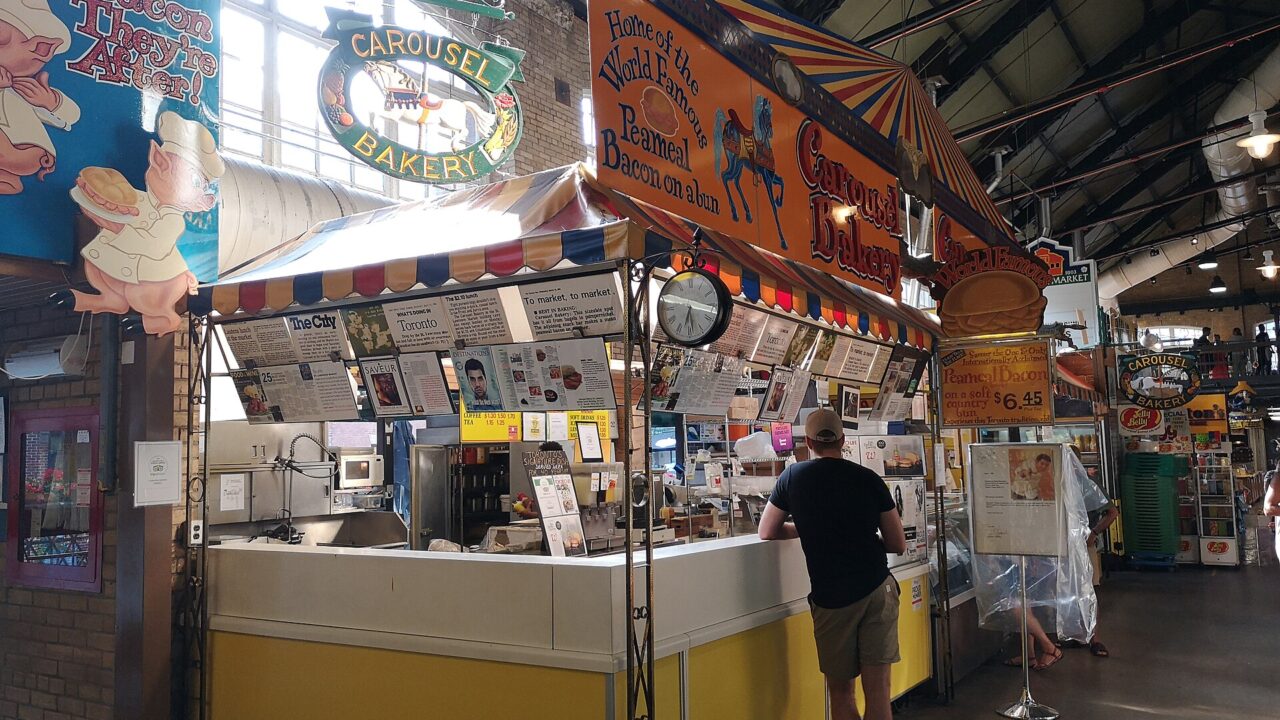
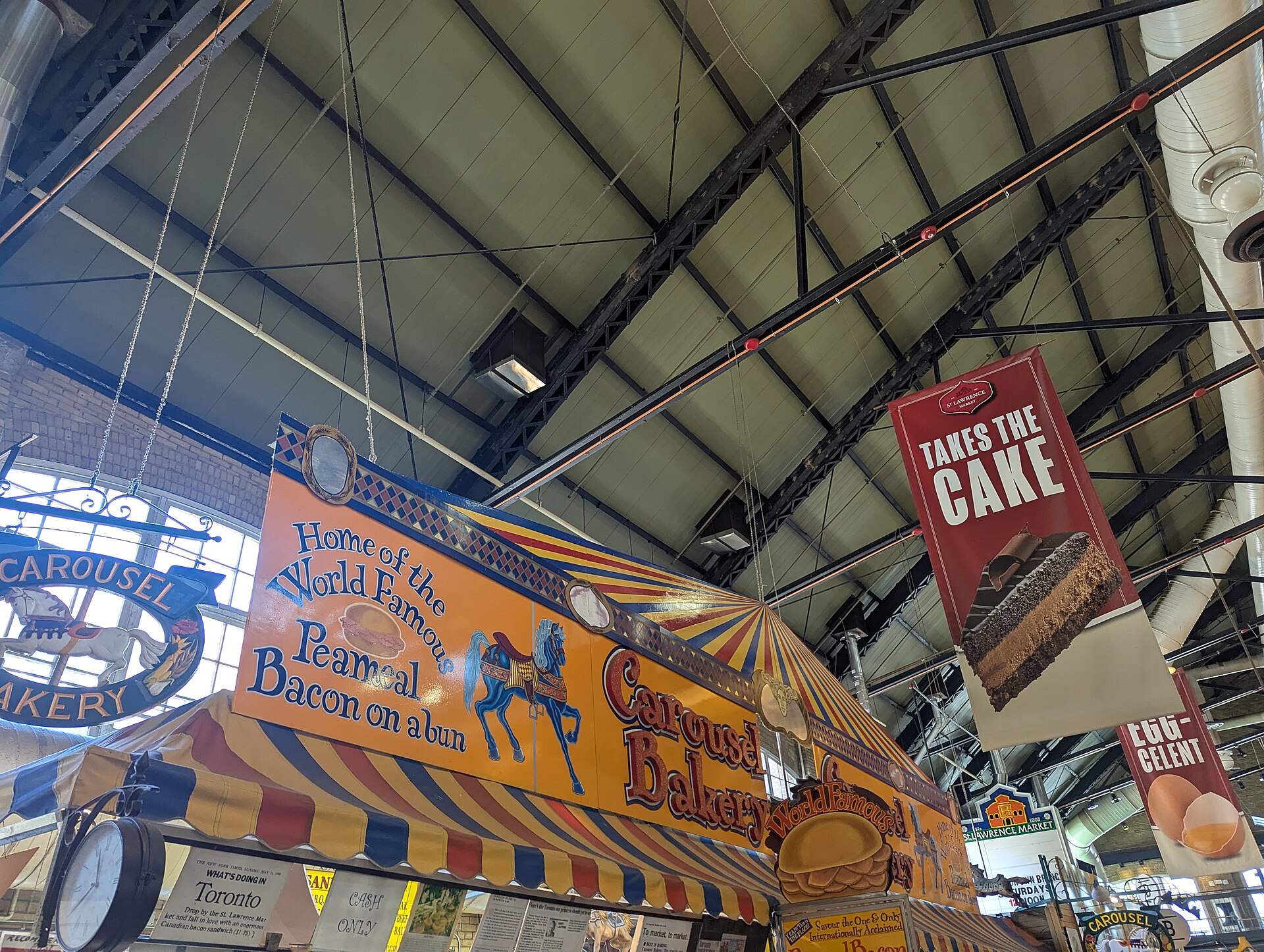
Carousel Bakery, at St Lawrence Market (Upper Level, stall 42), is the place to try the peameal bacon sandwich. It has been serving it for more than fifty years, and its stall — plastered with press clippings and a sign proclaiming the “World-Famous Peameal Bacon Sandwich” — is one of the most photographed food counters in the city. There is usually a queue at lunch on Saturdays; it moves quickly. Eat it standing up in the market, or take it outside to the benches along Front Street.
Is it worth the hype? Yes, with one caveat: it is a very good, very simple sandwich, not a revelation. Its appeal is being a genuinely local thing, eaten in a genuinely historic market, for not much money. Go hungry, get the sandwich, and then walk the rest of the market. Our St Lawrence Market guide covers the other vendors and the Saturday farmers’ market.
The Jamaican Beef Patty
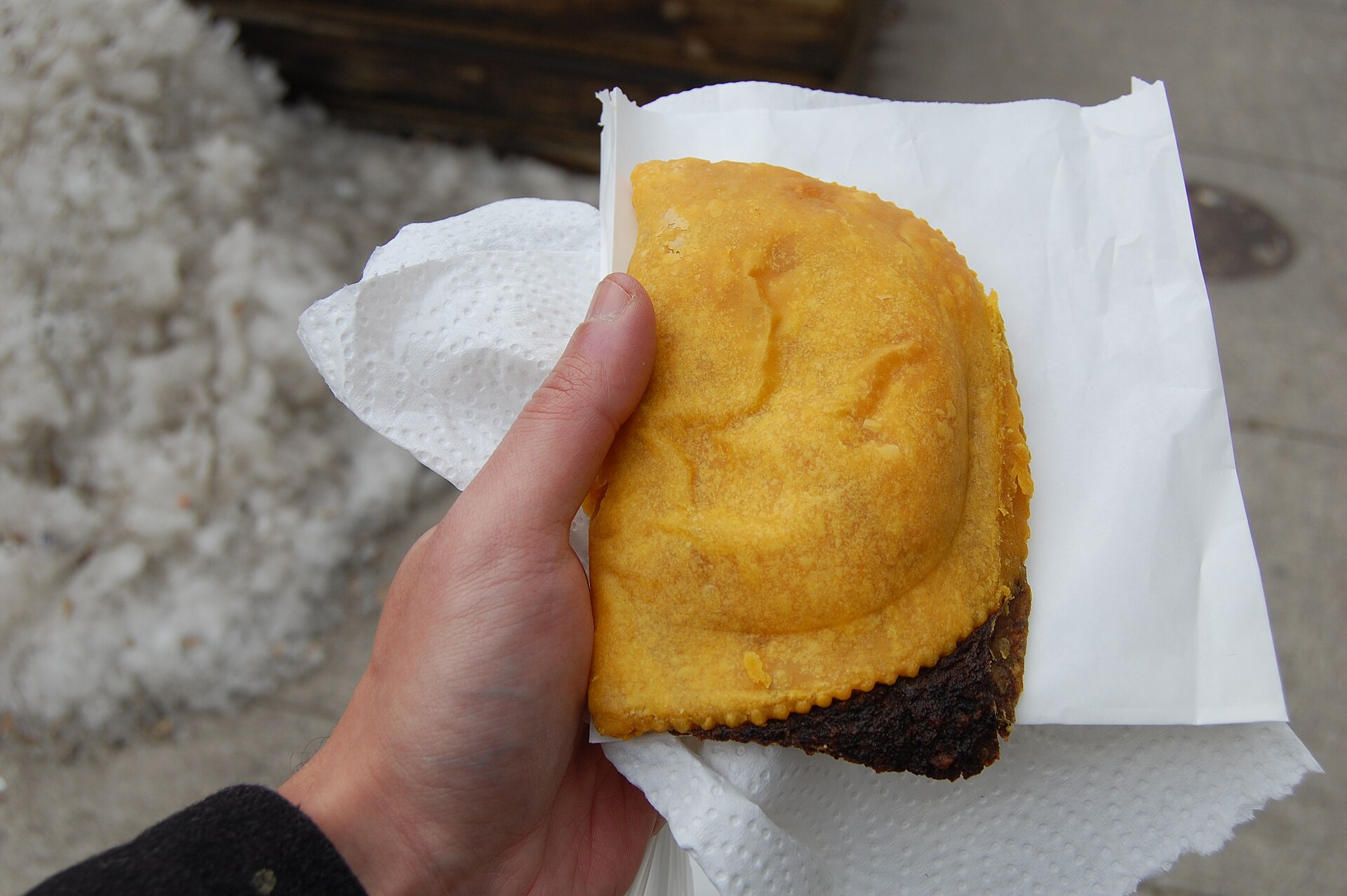
Toronto has a substantial Caribbean community, with over 6% of the city’s population of Caribbean descent, and its most visible culinary gift to the city is the patty: a half-moon of flaky, bright yellow pastry — the colour comes from turmeric or curry powder — filled with ground beef seasoned with Scotch bonnet pepper, thyme and allspice. Chicken, vegetable, goat and other fillings exist, but beef is the classic.
Patties are sold in Caribbean bakeries, takeout shops, convenience stores and school cafeterias across the city, and for a generation of Torontonians of every background a patty is simply what you eat when you need lunch in a hurry.
How to eat it like a local
- Patty in coco bread. Ask for your patty stuffed inside a split piece of coco bread, a soft, slightly sweet Jamaican bread. It is a carbohydrate sandwich of the highest order.
- With cheese. A slice of processed cheese melted onto a beef patty is a local favourite that purists frown on.
- Hot. A patty that has been sitting in a warmer too long goes soggy. Buy from somewhere busy.
Where to eat one
Kensington Market is the easiest place for a visitor to find a good patty. Golden Patty at 187 Baldwin Street is a good place to start. Neighbourhoods with large Caribbean communities, including Eglinton West — long known as Little Jamaica — and parts of Scarborough and the northwest of the city, have the widest choice. Our Kensington Market guide will help you find your way around.
An honest note: the frozen patties sold in convenience stores and some fast-food chains are a pale imitation. Worth trying once for the nostalgia, not for the flavour.
Roti
The other great Caribbean contribution to Toronto’s diet arrived with Trinidadian and Guyanese communities, whose roti — a soft, flaky flatbread wrapped around a filling of curried chicken, goat, beef, shrimp or chickpeas and potato — became a Toronto takeout classic. A proper West Indian roti is enormous, messy and cheap; you eat it with a knife and fork or very carefully with your hands. Look for “boneless” if you do not want to navigate chicken or goat bones.
Alongside roti you will often find doubles, the Trinidadian street snack of two pieces of fried bread filled with curried chickpeas and chutneys, which makes a brilliant mid-morning snack.
For the traditional version, head to the West Indian shops in the city’s Caribbean neighbourhoods, particularly along Eglinton Avenue West and in Scarborough.
The Butter Tart
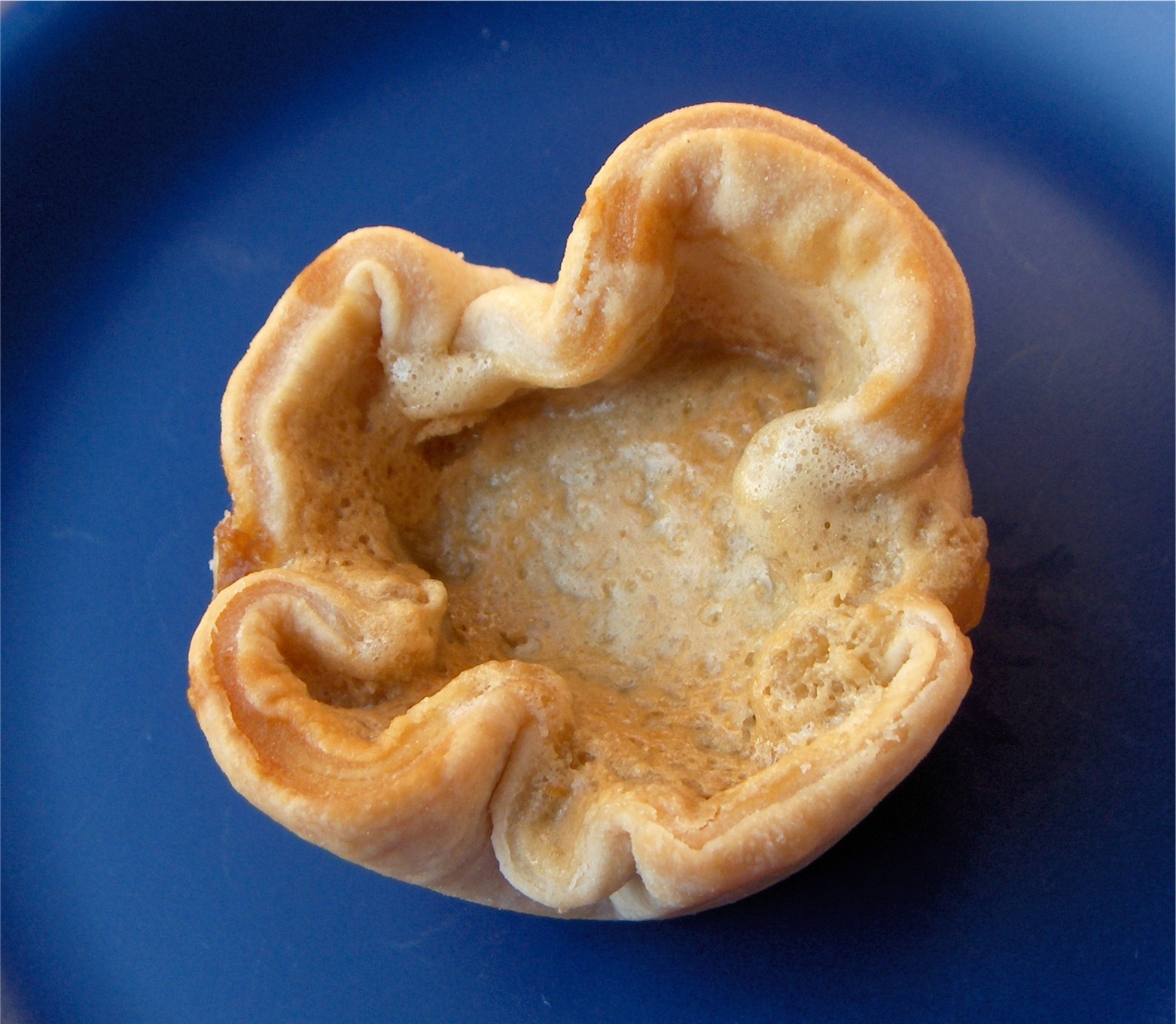
The butter tart is Ontario’s great contribution to dessert: a small, open pastry shell filled with butter, sugar, syrup and egg, baked until the filling is just set on top and still runny underneath. It is intensely sweet and almost impossible to eat without dripping. One of the earliest published recipes appeared in a charity cookbook from Barrie, north of Toronto, around 1900, and the tart has been a fixture of Ontario church bake sales, farm stands and bakery counters ever since.
The great debates
- Raisins or no raisins? The single most divisive question in Ontario baking. Plain, raisin and pecan are the standard options; walnut, maple and chocolate versions also exist.
- Runny or firm? A good butter tart should have some flow. A filling set solid is a sign of overbaking.
- Pastry. Flaky, lard- or butter-based, and not too thick.
Where to eat one
You will find butter tarts in bakeries throughout the city. Carousel Bakery at St Lawrence Market sells them alongside its peameal sandwiches, and the market’s other bakery stalls are a natural place to look. If you are driving north through cottage country in summer, the small-town bakeries of Ontario often make the best ones of all — see our Muskoka guide.
Street Meat
“Street meat” is what Torontonians call the hot dogs and sausages grilled on carts parked outside City Hall, at Queen and University, around the university campus and at the big sports and concert venues. You choose your meat — a regular hot dog, a jumbo, a spicy Italian or Polish sausage, often a veggie dog — and the vendor chars it on the grill, splits it and puts it in a bun. Then you head to the self-serve topping rack: onions, relish, sauerkraut, hot peppers, pickles, corn, bacon bits, several mustards.
It is not gourmet, and nobody pretends it is. It is fast, cheap and satisfying, and eating one on a bench in Nathan Phillips Square is as Toronto as lunch gets.
Sushi Pizza
A crisp, deep-fried patty of sushi rice, topped with raw salmon or tuna, avocado, spicy mayonnaise and tobiko, and cut into wedges. It is a fixture of the city’s Japanese restaurant menus. Nami, on Adelaide Street East, is one downtown Japanese restaurant where you can try it. It is not refined, it is surprisingly good, and it is a must-try if you like to eat things you will not find on every menu. Our best sushi in Toronto guide covers the rest of the scene, from omakase counters to all-you-can-eat.
Dim Sum, Chinatown and Hakka
Toronto’s Chinese food is one of its great strengths, thanks to waves of immigration from Hong Kong, southern China and, later, mainland China and Taiwan. Two styles in particular are part of the city’s identity.
Dim sum
Weekend dim sum — har gow, siu mai, char siu bao, rice rolls and egg tarts — is a Toronto institution for families of every background. Downtown Chinatown on Spadina Avenue has classic banquet halls and newer spots, but many locals would tell you the very best dim sum in the region is in the northern suburbs of Scarborough, Markham and Richmond Hill. Our best dim sum in Toronto guide names names, and the Chinatown guide covers the neighbourhood, including its barbecue shops with roast duck and char siu hanging in the window.
Hakka Chinese
Here is the one visitors rarely know about. Hakka Chinese food in Toronto usually means Indian-Chinese cuisine, developed by the Hakka Chinese community in Kolkata and brought to Toronto by immigrants from India. Think chili chicken, Manchurian dishes, hot garlic sauce, and “Hakka noodles” — spicy, saucy, deeply satisfying food that exists at scale in very few cities outside India. If you have a car or a free evening, it is one of the most distinctive meals you can have in the Toronto area.
The Other Dishes That Make Toronto
Toronto’s food identity is its multiculturalism, and a list like this could run for pages. A handful more that locals would add:
- The veal sandwich. A thick breaded veal cutlet in tomato sauce on a crusty bun, with hot peppers and mushrooms, is the defining sandwich of Toronto’s Italian community. California Sandwiches, on Claremont Street near Little Italy, has been making them for decades. See our Little Italy guide.
- Portuguese custard tarts. Pastéis de nata, still warm from the oven, from the bakeries of Little Portugal along Dundas Street West.
- Souvlaki on the Danforth. Toronto’s Greektown, along Danforth Avenue, is lined with souvlaki and grilled-meat restaurants, at its liveliest on summer evenings.
- Korean fried chicken. Koreatown on Bloor Street West, around Christie, is full of Korean restaurants and late-night fried chicken spots.
- Bannock. The traditional Indigenous bread, fried or baked, served at Tea N Bannock on Gerrard Street East, an Indigenous-owned restaurant. Our Indigenous experiences guide covers more.
- Pho, banh mi and Vietnamese sandwiches on Spadina and in the east end.
- Ethiopian and Eritrean food along Danforth Avenue east of Greektown.
Chains Canadians grew up with
Two restaurant chains that most Canadians grew up with are Swiss Chalet, the rotisserie chicken chain famous for its “Chalet sauce”, and Pizza Pizza, with its orange branding and jingle-worthy phone number. Neither is a culinary destination, and you will not find them in food guides — but for many Torontonians they are the taste of childhood, and if you want to eat the way the city actually eats on a weeknight, you could do worse.
What Toronto Is Not Known For
Tourist menus in Toronto are full of “Canadian classics” that come from somewhere else entirely. None of them are bad — some are excellent — but here is the honest geography.
- Poutine is from Québec. You will find it all over Toronto, but it is not a Toronto dish, and the tourist-trap versions with limp fries and grated mozzarella in place of squeaky curds are best avoided. Fresco’s Fish and Chips in Kensington Market lists Quebec-style poutine on its menu. The real thing is about five hours away by train; see our Montréal by train guide.
- Montréal-style bagels and smoked meat are, as the name suggests, from Montréal.
- Nanaimo bars — the three-layer no-bake squares — come from Nanaimo in British Columbia, though you can buy them at St Lawrence Market.
- BeaverTails, the fried-dough pastries, started in the Ottawa area.
- Tim Hortons opened its first shop in Hamilton, just down the lake.
- Maple syrup is Canadian, but most of it comes from Québec. Ontario does make some, and the spring sugar-bush season is a lovely day trip.
A One-Day Classic Toronto Food Crawl
You can eat most of Toronto’s defining dishes in a single, very full day on foot and by transit. Here is a route that works.
- Breakfast, St Lawrence Market (from 9am Tuesday to Friday, 7am Saturday, 10am Sunday). A peameal bacon sandwich at Carousel Bakery. Buy a butter tart for later. The market is closed on Mondays, so plan this stop for another day.
- Mid-morning walk. Stroll west along Front Street and up to Nathan Phillips Square, about twenty minutes.
- Early lunch, City Hall (11:30am). Street meat from a cart outside Nathan Phillips Square.
- Kensington Market and Chinatown (1pm). Take the 505 Dundas streetcar west, or walk. A Jamaican beef patty from Golden Patty on Baldwin Street, then a wander through Chinatown on Spadina for an egg tart or a bao.
- Afternoon, Little Portugal (3pm). Continue west along Dundas Street for a warm Portuguese custard tart and an espresso.
- Dinner (7pm). Sushi pizza at a Japanese restaurant downtown, or head up to Little Italy for a veal sandwich.
- Late night, Queen West (10pm). A late-night roti from a takeout shop on Queen West.
And eat that butter tart whenever you need it. If you would rather have someone else plan the route, a guided food tour is a good way to cover several of these at once: Tasty Tours Toronto runs a Kensington Market tour at $89 per person, and Secret Food Tours offers a St Lawrence Market and Old Town tour from $99.99. Our best food tours in Toronto guide compares the options, and the Toronto street food guide covers more quick bites.
Where to Find Toronto’s Classic Foods in One Place
St Lawrence Market
The closest thing Toronto has to a one-stop shop for local classics: peameal bacon sandwiches, butter tarts, Canadian cheeses, maple products, Nanaimo bars, and around a hundred vendors under one roof. It is not open every day, so check the hours before you go, and there is a farmers’ market on Saturday mornings. Saturdays are very busy; go early.
Kensington Market
A crowded, bohemian neighbourhood of independent shops, cafés and food stalls with a very international mix: Jamaican patties, empanadas, tacos, fish and chips, and a great deal more. Pedestrian Sundays in summer close the streets to cars.
Food halls and festivals
Toronto’s summer neighbourhood food festivals and prix-fixe events like Winterlicious and Summerlicious are good ways to sample widely. Our Toronto food markets guide covers the city’s markets and food halls, and the Winterlicious and Summerlicious guide explains the set-menu festivals.
Taking Toronto’s Flavours Home
Most of the dishes on this list are best eaten on the spot — a patty or a peameal sandwich does not survive a suitcase — but a few Toronto and Ontario tastes travel well.
- Butter tarts keep for a day or two in a sturdy box, long enough for a short flight or a drive home. Buy them the morning you leave.
- Maple syrup and maple products are sold at St Lawrence Market and all over the city. Glass bottles are prettier; tins and plastic survive checked luggage better.
- Ontario icewine, the sweet dessert wine made from frozen grapes in the Niagara region, makes a classic gift. Bottles are sold at LCBO stores and the wineries themselves, and duty-free allowances apply.
- Jamaican patty seasoning and hot sauces from Caribbean grocers let you attempt the real thing at home.
- Canadian chocolate bars and snacks — Coffee Crisp, ketchup chips and the rest — are cheap, light and much appreciated by anyone who has lived in Canada.
A word of warning on meat: check your home country’s customs rules before you pack a slab of peameal bacon. Our Toronto souvenirs guide has more gift ideas, and the Niagara-on-the-Lake wine guide covers where icewine comes from.
Frequently Asked Questions
What food is Toronto most famous for?
The peameal bacon sandwich, which was declared Toronto’s official signature dish in 2016. The best-known place to eat one is Carousel Bakery at St Lawrence Market. The Jamaican beef patty and the butter tart are close behind.
What is Toronto’s signature dish?
Officially, the peameal bacon sandwich: griddled, cornmeal-crusted cured pork loin on a soft bun. It reflects the city’s history as “Hogtown”, a 19th-century centre of pork packing.
What is peameal bacon?
A lean, wet-cured and unsmoked pork loin rolled in cornmeal. The name comes from the ground yellow peas that were originally used for the coating. It is sliced thick and griddled, and it is quite different from streaky bacon.
Is poutine from Toronto?
No. Poutine comes from Québec. You can find it all over Toronto, but it is not a Toronto dish.
Where can I get a good Jamaican patty in Toronto?
Kensington Market has Golden Patty on Baldwin Street, and Toronto’s Caribbean neighbourhoods, including Eglinton West, have many more.
Are butter tarts from Toronto?
They are from Ontario. One of the earliest published recipes appeared in a Barrie cookbook around 1900, and you will find them in bakeries across Toronto.
What is sushi pizza?
A crispy, deep-fried rice patty topped with raw fish, avocado, spicy mayo and roe, cut into wedges. It is found on Japanese restaurant menus across the city and rarely elsewhere.
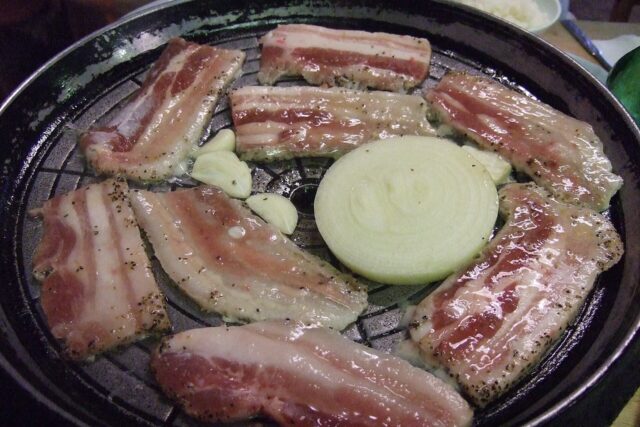
Korean barbecue belongs on any list of meals that taste like modern Toronto. You grill pork belly and short rib at the table, wrap them in lettuce with ssamjang and garlic, and pass round the soju. Koreatown on Bloor Street West is the obvious place to start. Our guide to the best Korean BBQ in Toronto covers the restaurants, the etiquette and the costs.
The butter tart is Ontario’s own pastry, and the earliest published Canadian recipe comes from a 1900 cookbook printed in Barrie, north of the city. Toronto bakeries sell them in every style: runny or firm, with raisins or without. Our guide to the best bakeries in Toronto covers where to find them, along with custard tarts, challah and pineapple buns.
Related Toronto Guides
- Toronto Food Guide — the pillar guide to eating in the city.
- St Lawrence Market Guide — home of the peameal bacon sandwich.
- Toronto Street Food Guide — more quick bites.
- Toronto’s Multicultural Food — the cuisines that define the city.
- Cheap Eats in Toronto — good food for less.
- Best Food Tours in Toronto — let someone else plan the crawl.
- Kensington Market Guide — patties, empanadas and more.
Photo Credits
Carousel Bakery stall at St Lawrence Market: Carousel Bakery by Leventio, CC BY-SA 4.0, via Wikimedia Commons.
Peameal bacon sandwich: Peameal bacon sandwich by Leventio, CC BY-SA 4.0, via Wikimedia Commons.
Butter tart: Butter tart by Stephanie Spencer, CC BY-SA 3.0, via Wikimedia Commons.
Carousel Bakery at St. Lawrence Market: Lunch time at St. Lawrence Market (54592317925) by Daniel, CC BY 2.0, via Wikimedia Commons.
A Jamaican beef patty from Toronto: Beef patty (3154002720) by stu_spivack, CC BY-SA 2.0, via Wikimedia Commons.