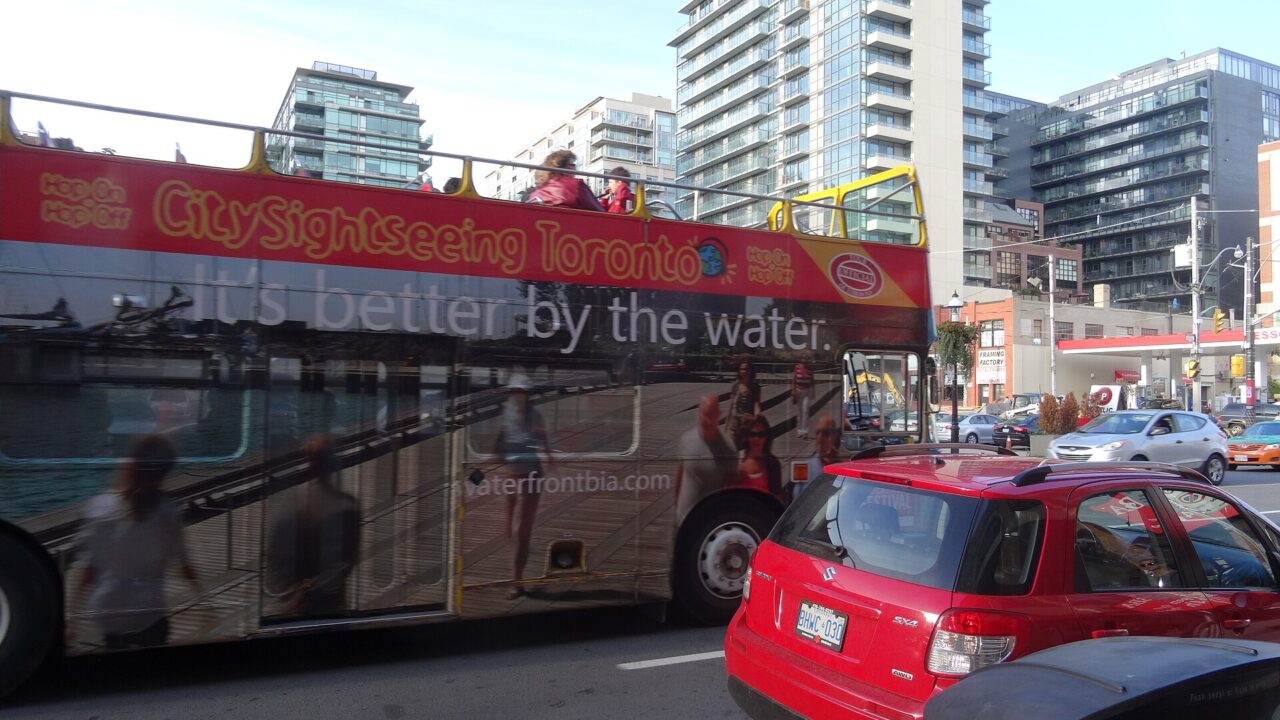
Stand on Front Street outside Union on a July afternoon and you will watch a red open-top double-decker sit through three cycles of the same traffic light. Upstairs, twenty people in ponchos are photographing the back of a delivery truck. Two hundred metres beneath them, a Line 1 train is doing the same journey in ninety seconds for $3.30. That gap — between what the Toronto hop on hop off bus promises and what Toronto’s street grid actually allows it to deliver — is the whole question, and it deserves a straight answer rather than a list of stops.
This guide gives you the route, the real prices, an honest verdict on whether it is worth the money, who it genuinely suits, and what to do instead if it does not. Prices were checked in September 2026 and are in Canadian dollars; the sightseeing operators reprice constantly and sell through half a dozen channels at different rates, so treat the figures as the right order of magnitude and always check the total at checkout.
At a Glance
| Detail | What to know |
|---|---|
| Operator | City Sightseeing Toronto (the main hop-on hop-off service) |
| Stops | 13 on a single loop |
| Full loop | About 2 hours 15 minutes without getting off |
| Vehicles | Open-top double-deckers in summer, enclosed trolleys in cold weather |
| 24-hour adult ticket | Roughly $48–$62 depending on channel |
| 48-hour ticket | Works out around $31 per day |
| Included | Audio guide in several languages, route map |
| The alternative | TTC Day Pass, $13.50 for unlimited travel |
What the Route Actually Covers
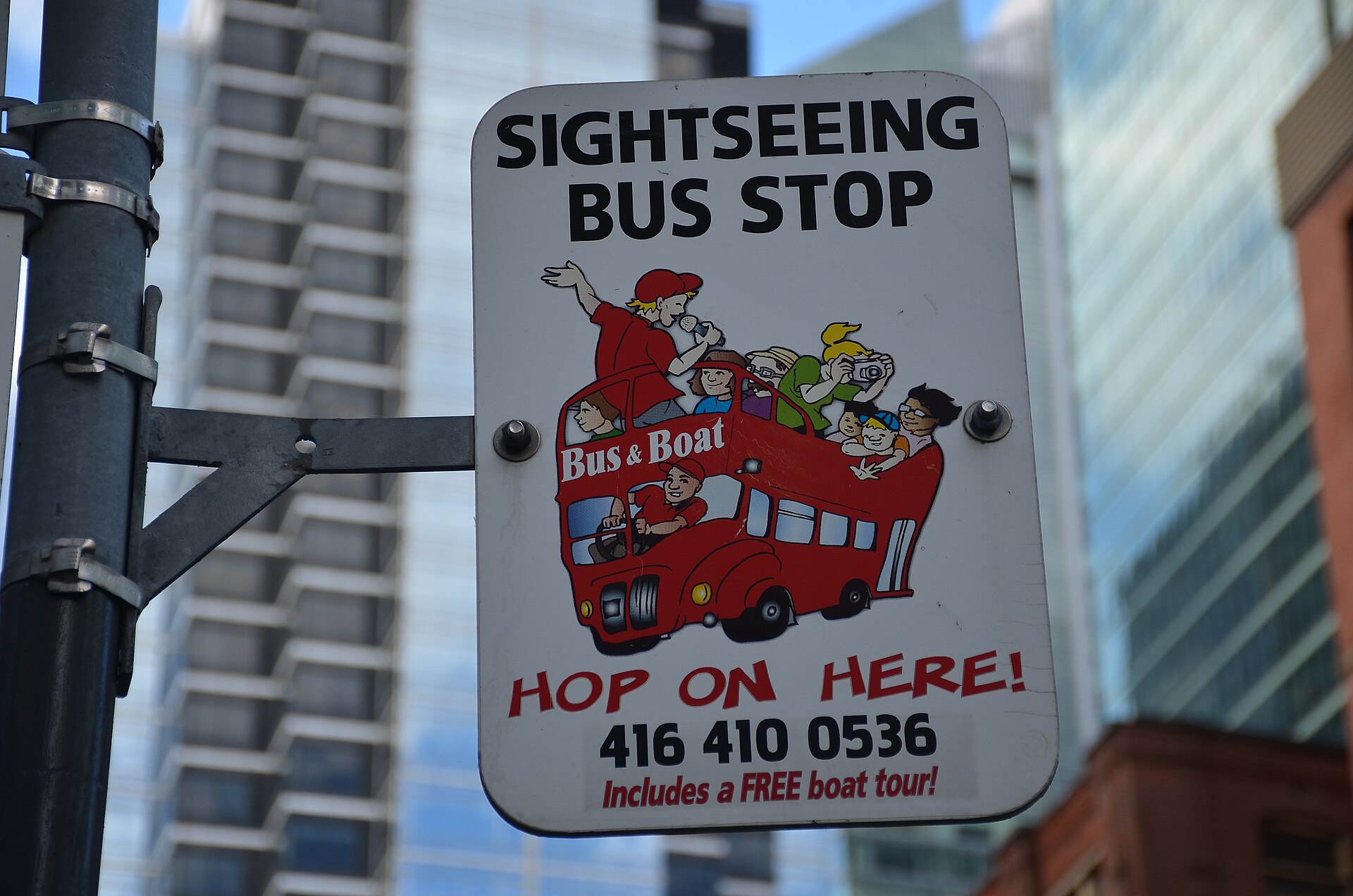
One loop, thirteen stops, and a route designed around the things visitors have already heard of. Without listing every stop — they shift slightly year to year, and the operator’s map is the authority — the loop covers the tourist spine of the city:
- The waterfront and Harbourfront, including the ferry docks and the cruise slips.
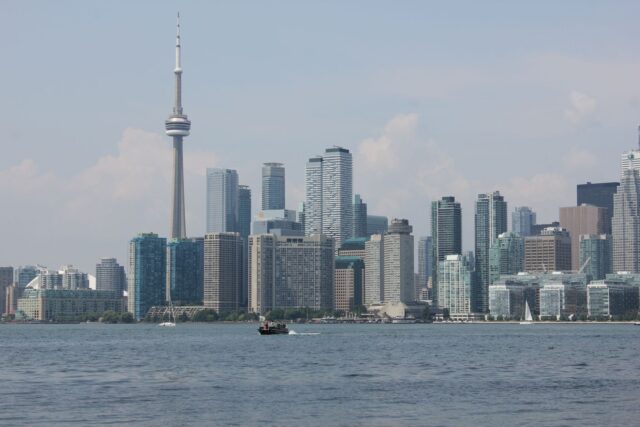
- The CN Tower, Rogers Centre and Ripley’s Aquarium cluster at the foot of downtown.
- The Distillery District in the east, which is the stop most worth getting off at.
- St. Lawrence Market and the Old Town, near the eastern end of Front Street.
- Yonge-Dundas Square and the Eaton Centre, the retail middle of the city.
- The Royal Ontario Museum and the Bloor–Yorkville area at the north end of the loop.
- Casa Loma, up the hill, which is the one stop that genuinely justifies a bus.
- Kensington Market and Chinatown on the western side.
The full circuit takes about two hours and fifteen minutes if you never get off. That number is worth holding on to, because it is the single most useful fact for planning: on a good day, a full loop plus three meaningful stops is most of your daylight.
What It Costs
Pricing is genuinely confusing, and that is not an accident. In September 2026, resale platforms were quoting around $48.50 for a 24-hour adult ticket, while the operator’s own site was quoting from $61.06, presumably with tax and fees folded in. A 48-hour ticket works out at roughly $31 per day, which is the only version of this product with a defensible price per hour.
Children and seniors are discounted, usually meaningfully. Tickets are typically valid for months from purchase rather than from the date you booked, so buying early does not lock you into a date — but it also means a “sale” price is rarely a limited-time offer in any real sense.
| What you buy | Typical cost (adult) | Cost per day |
|---|---|---|
| 24-hour hop-on hop-off | $48–$62 | $48–$62 |
| 48-hour hop-on hop-off | $62–$75 | About $31 |
| Bus and boat combo | $85–$110 | Varies |
| TTC Day Pass (the alternative) | $13.50 | $13.50 |
| TTC single fare with PRESTO | $3.30 | Two-hour transfers included |
The Honest Verdict: Is It Worth It?
For most visitors to Toronto: no. Here is the arithmetic that leads there, laid out honestly, because plenty of people will still find the answer is yes.
Toronto is unusually badly suited to a hop-on hop-off bus, for three reasons that have nothing to do with the operator.
First, the traffic. Downtown Toronto’s streets are a dense grid with streetcar tracks down the middle of the main east–west routes, constant construction and no bus lanes on the tourist loop. A bus is not merely as slow as the traffic; it is slower, because it also stops. The two-hour-fifteen loop is a good-day figure.
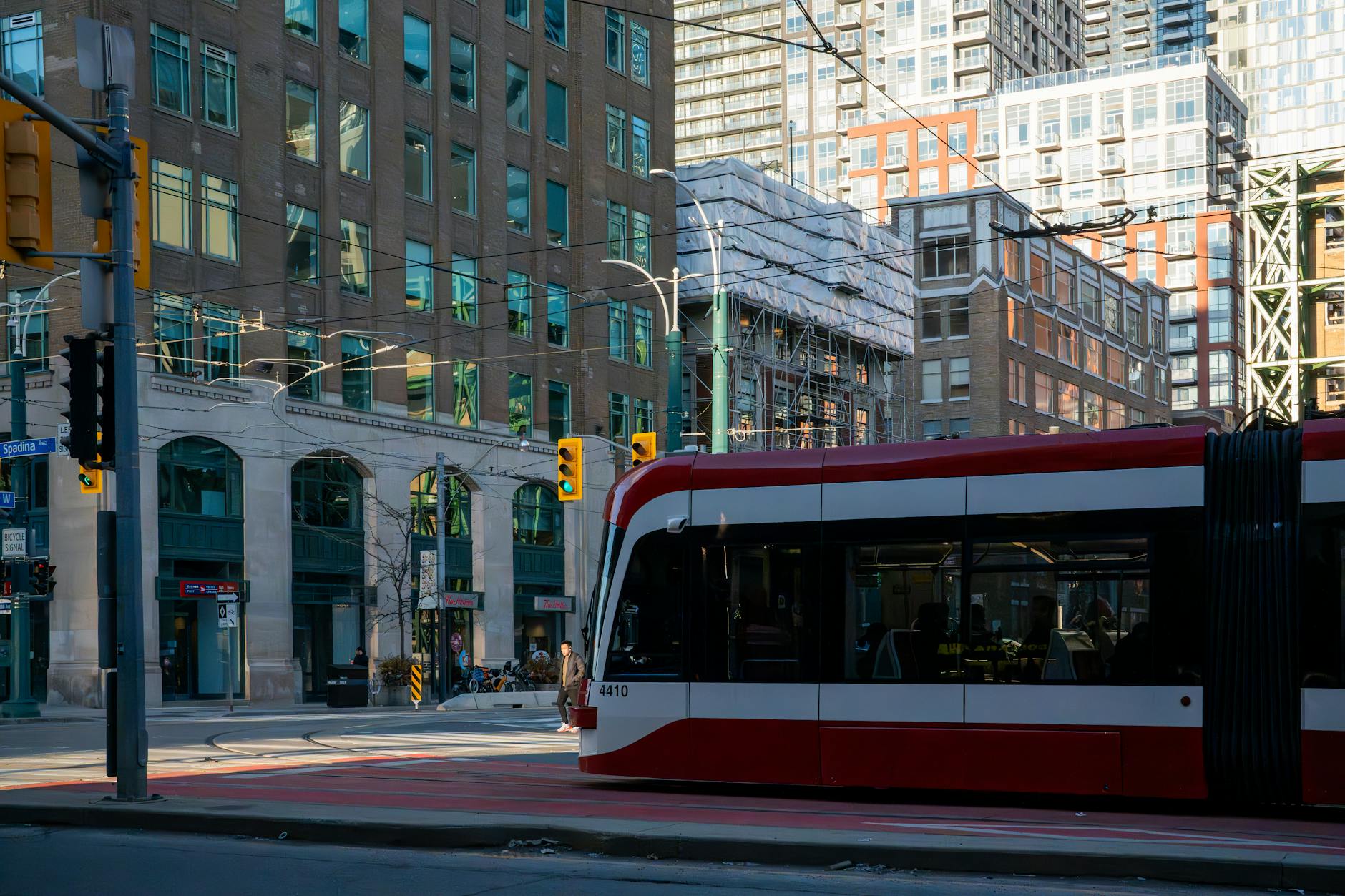
Second, the subway is genuinely fast and genuinely cheap. Line 1 is a U shape whose two legs run directly under most of what visitors want to see, with Union at the bottom. Getting from Union to the ROM takes about twelve minutes underground and costs $3.30, or $13.50 for a whole day of unlimited travel on a Day Pass — a quarter of what the bus charges. Our TTC guide covers the network and the PRESTO guide covers paying for it.
Third, downtown Toronto is walkable and the good bits are close together. The distance from the CN Tower to Yonge-Dundas Square is about twenty-five minutes on foot, through the Financial District and the PATH. Kensington Market, Chinatown and the AGO are a fifteen-minute walk from each other. A bus that takes you between things you could walk between is selling you a seat, not a saving.
The thing the bus does do well is the audio commentary. If your interest is in having Toronto explained to you rather than merely getting around it, that has real value, and there is no equivalent on a subway train. But a good walking tour does the same job better and for less; see our Toronto walking guide.
Who it does work for
- Visitors with limited mobility. Toronto’s older subway stations are not all step-free, and a bus that stops outside the attraction door is worth paying for. This is the single strongest case for the product.
- One day in the city, and orientation matters more than depth. Two hours on the top deck gives you a map in your head that a subway tunnel cannot.
- Cruise passengers and stopovers with a fixed window and no appetite for working out a fare system.
- Cold or wet weather, where an enclosed trolley circulating between indoor attractions is a genuinely comfortable way to spend a bad day. Our rainy-day guide has the alternatives.
- Anyone going to Casa Loma. It sits at the top of a hill above the Line 1 station and the walk up is the one journey in central Toronto where a bus is properly useful.
Who should skip it
- Anyone in Toronto for three days or more. Buy a PRESTO card, learn the two subway lines in an afternoon, and spend the difference on dinner.
- Anyone travelling with children who dislike sitting still. Two hours on a bus is a long time; the Islands ferry costs a fraction and children actually enjoy it.
- Anyone visiting mainly the downtown core. You will walk faster than the bus moves.
- Anyone on a budget. The gap between $48 and $13.50 buys a very good lunch.
How It Compares to the Alternatives
| Option | Cost | What you get | Verdict |
|---|---|---|---|
| TTC Day Pass | $13.50 | Unlimited subway, streetcar and bus for a day | Best value by a distance |
| Walking tour | $25–$50, some pay-what-you-wish | A guide, in person, answering questions | Best for context |
| Hop-on hop-off, 48 hours | About $31 per day | Loop, commentary, seat | The defensible version |
| Hop-on hop-off, 24 hours | $48–$62 | Same, in less time | Hard to justify |
| Harbour cruise | $35–$45 | The skyline from the water | Better hour on the water |
| CityPASS | Varies | Bundled attraction admission | Depends on your list |
If you are weighing bundles generally, our Toronto CityPASS guide works through when the attraction bundles pay for themselves and when they quietly do not, and the harbour cruises guide does the same for the boats.
If You Do Buy One, Use It Properly
Assuming you have decided the bus suits your trip, a few things make it work considerably better.
- Buy 48 hours, not 24. The per-day cost roughly halves, and one loop plus a proper stop at the Distillery District already fills a day.
- Ride the full loop first, then hop. Take the whole circuit as an orientation lap with the commentary on, note the three stops you actually want, then go back to them. Getting off at stop two on your first pass wastes the map-in-your-head effect entirely.
- Start early. The first departures of the day run in genuinely lighter traffic; by two in the afternoon the loop takes noticeably longer than advertised.
- Sit upstairs at the front, on the right-hand side. The route runs the good views on the right more often than the left, and the front is where the audio and the sightlines are best.
- Do not plan a timed attraction entry around a bus arrival. Frequency varies by season and time of day and traffic makes it unreliable. If you have a timed ticket to the CN Tower, get there another way.
- Bring layers and sun protection. An open top deck in July is hotter than the street, and in September it is colder.
- Check whether your ticket day starts on first tap or on purchase. A 24-hour ticket activated at 4pm on your arrival day is a 24-hour ticket mostly spent asleep.
Which Stops Are Actually Worth Getting Off At
If you have a 24-hour ticket, you have time for about three real stops around a full loop. These are the ones that repay the hop, ranked by how much better they are for having arrived by bus rather than by subway.
- Casa Loma. The one unambiguous case. The house is a genuinely strange Edwardian folly with a tunnel, stables and a view over the whole city, and it sits at the top of a hill that the subway leaves you at the bottom of. Allow ninety minutes inside. Our Casa Loma guide covers what to see and when to go.
- The Distillery District. Cobbled Victorian industrial streets, galleries, and the best coffee-and-wander stop on the route. It is a fifteen-minute walk or a short streetcar ride from the nearest subway, so the bus saves you something real. Two hours goes easily. See the Distillery District guide.
- St. Lawrence Market. Best in the morning and closed on Mondays, which catches out a remarkable number of visitors. Half an hour if you are browsing, an hour if you are eating. The St. Lawrence Market guide has the stalls worth queuing for.
- Kensington Market and Chinatown. The most characterful hour on the loop and the part of Toronto least like anywhere else. The bus stop saves you a ten-minute walk from the Spadina streetcar, which is not much, but the neighbourhood is worth the stop regardless.
- The CN Tower cluster. Worth getting off at only if you have a timed ticket, in which case do not rely on the bus to get you there on schedule.
Stops that are not worth the hop: Yonge-Dundas Square, which is a busy intersection with screens on it; the Eaton Centre, which is a shopping mall you can reach from three subway stations; and most of the waterfront stops, which are within a fifteen-minute walk of each other along a pleasant lakeside path you would rather be on. Our Toronto attractions guide rates the whole list on whether each is worth the entry price, which is a separate question from whether it is worth the bus.
The Bus and Boat Combo
The operator sells a combined ticket bundling the bus loop with a harbour and islands cruise, which typically lands somewhere between $85 and $110. Whether it is worth it depends entirely on whether you were going to do the boat anyway. If you were, the combo usually saves something real. If you were not, you have just paid extra for a product you did not want in order to feel that you got a deal — the oldest trick in the tourism business.
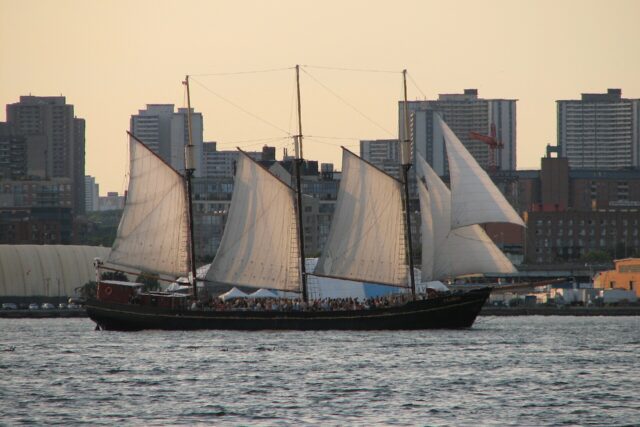
A sharper version of the same day: TTC Day Pass at $13.50, walk the downtown core, and put the saved money into a proper cruise of your choosing. Our harbour cruises guide covers what is actually on the water, from an hour-long narrated loop to the tall ship.
Accessibility, Comfort and the Small Print
The strongest argument for the bus is the one the marketing makes least of, so it is worth setting out properly.
Toronto’s subway is fast but it is not uniformly step-free. A substantial number of the older stations on Lines 1 and 2 still lack lifts, the accessible ones are not always the ones nearest your destination, and the streetcar fleet — while low-floor and ramp-equipped — depends on a working ramp and a driver with time to deploy it. If stairs are a problem, a vehicle that stops on the street outside the attraction and lets you sit down between stops is a genuinely different proposition from a $13.50 Day Pass, and the price gap stops looking like the point.
Two caveats on that. The upper deck is reached by a narrow internal staircase and is not accessible; the lower deck has fewer windows and a much worse view. And wheelchair provision varies by vehicle in the fleet, so contact the operator directly and confirm for the specific departure rather than relying on a symbol on a booking page.
A few other pieces of small print that catch people out:
- Validity windows differ by seller. Some tickets run 24 hours from first boarding; others expire at the end of the following calendar day. These are meaningfully different products at the same price.
- Refunds are rare, date changes are usually free. If the forecast turns, move the date rather than trying to cancel.
- The audio guide needs your own headphones on some vehicles. Bring a pair; the disposable ones are unpleasant.
- Last departures are earlier than you think, particularly outside July and August. Check the final loop time before you plan a late stop, because being stranded at Casa Loma at dusk means an unplanned taxi.
- Buggies and pushchairs generally need to be folded and stowed, which is awkward on a busy summer loop.
- Toilets. There are none on board. The loop is two and a quarter hours.
Season and Weather
Open-top double-deckers run in the warm months; in cold weather the operator switches to enclosed trolley-style vehicles, which are far more comfortable and considerably less fun. The service runs year-round but frequency drops outside the summer, and in deep winter a hop-on hop-off ticket is a fairly expensive way to sit in traffic looking at grey buildings through a fogged window.
The sweet spot is late May to early October. September is best of all — warm enough for the top deck, past the peak of the summer traffic, and with the clearest light of the year on the skyline. Our best time to visit Toronto guide sets the seasons out properly.
What to Do Instead
If you have read this far and decided against the bus, here is the version of the day that most people enjoy more, for about a quarter of the money.
- Morning: Buy a Day Pass at $13.50. Line 1 north to the Royal Ontario Museum or up to Casa Loma, whichever you would rather see properly.
- Midday: Subway back down to Queen, walk west through Kensington Market and Chinatown, eat there.
- Afternoon: The 504 King or 501 Queen streetcar east to the Distillery District — the streetcar ride down King is the free sightseeing tour nobody sells you.
- Late afternoon: Walk south to the waterfront and take the Islands ferry for the skyline view.
- Evening: Back downtown for dinner, still holding the same $13.50 pass.
Our one day in Toronto itinerary builds this out properly, and things to do in Toronto covers the wider list.
Frequently Asked Questions
How much is the Toronto hop-on hop-off bus?
Roughly $48–$62 for a 24-hour adult ticket depending on where you buy it; the operator’s own site was quoting from $61.06 in September 2026 while resale platforms were around $48.50. A 48-hour ticket works out at about $31 per day. Children and seniors are discounted.
Is the hop-on hop-off bus worth it in Toronto?
For most visitors, no. Toronto’s downtown is compact and walkable, the subway is fast and a Day Pass costs $13.50 against $48 or more for the bus, and the bus sits in the same traffic as everyone else. It is worth it if you have limited mobility, only one day, or want the commentary and the seat.
How many stops are there and how long is the loop?
Thirteen stops on a single route, and the full circuit takes about two hours and fifteen minutes if you stay on board. Allow longer in afternoon traffic.
Does the ticket include a boat cruise?
Not the standard ticket. There is a separate bus-and-boat combination ticket that bundles the loop with a harbour and islands cruise, typically $85–$110.
Does it run in winter?
Yes, but with enclosed trolley-style vehicles instead of open-top double-deckers and reduced frequency. It is a considerably less appealing product in January than in July.
Is there a cheaper way to see the same sights?
A TTC Day Pass at $13.50 covers unlimited subway, streetcar and bus travel for a day and reaches every stop on the hop-on hop-off route. Riding the 504 King or 501 Queen streetcar end to end is a genuinely scenic tour of the city for a single $3.30 fare.
Is the audio commentary any good?
It is competent and available in several languages, and it is the main thing the ticket buys that public transport cannot. If context is what you want, a live walking tour with a guide who can answer questions is better value again.
Where do you buy tickets?
Online through the operator, through the major activity marketplaces, or from staff at the main downtown stops. Prices differ by channel — compare the total including tax and fees before you commit, because the headline figure and the checkout figure are often different numbers.
Can you get on and off as many times as you want?
Yes, within the ticket’s validity window. The practical limit is frequency: every hop costs you the wait for the next bus, which is why one full orientation loop followed by two or three deliberate stops works better than hopping constantly.
Is it good for children?
Mixed. The open top deck is a novelty and the first twenty minutes go well; two hours in traffic rarely does. The Islands ferry, the streetcar and the CN Tower lift all hold attention better for less money — see our Toronto with kids guide.
Related Toronto Guides
- Best Tours in Toronto — the pillar guide to every kind of tour in the city.
- Toronto TTC Guide — the subway, streetcars and how to actually get around.
- Toronto Attractions — what the bus stops outside, and whether each is worth the entry.
- Toronto CityPASS Guide — when attraction bundles pay for themselves.
- Walking Toronto — the routes that beat the bus.
- Getting Around Toronto — every mode, compared on cost and speed.
- Toronto Harbour Cruises — the boats, and which combo tickets are worth it.
Photo Credits
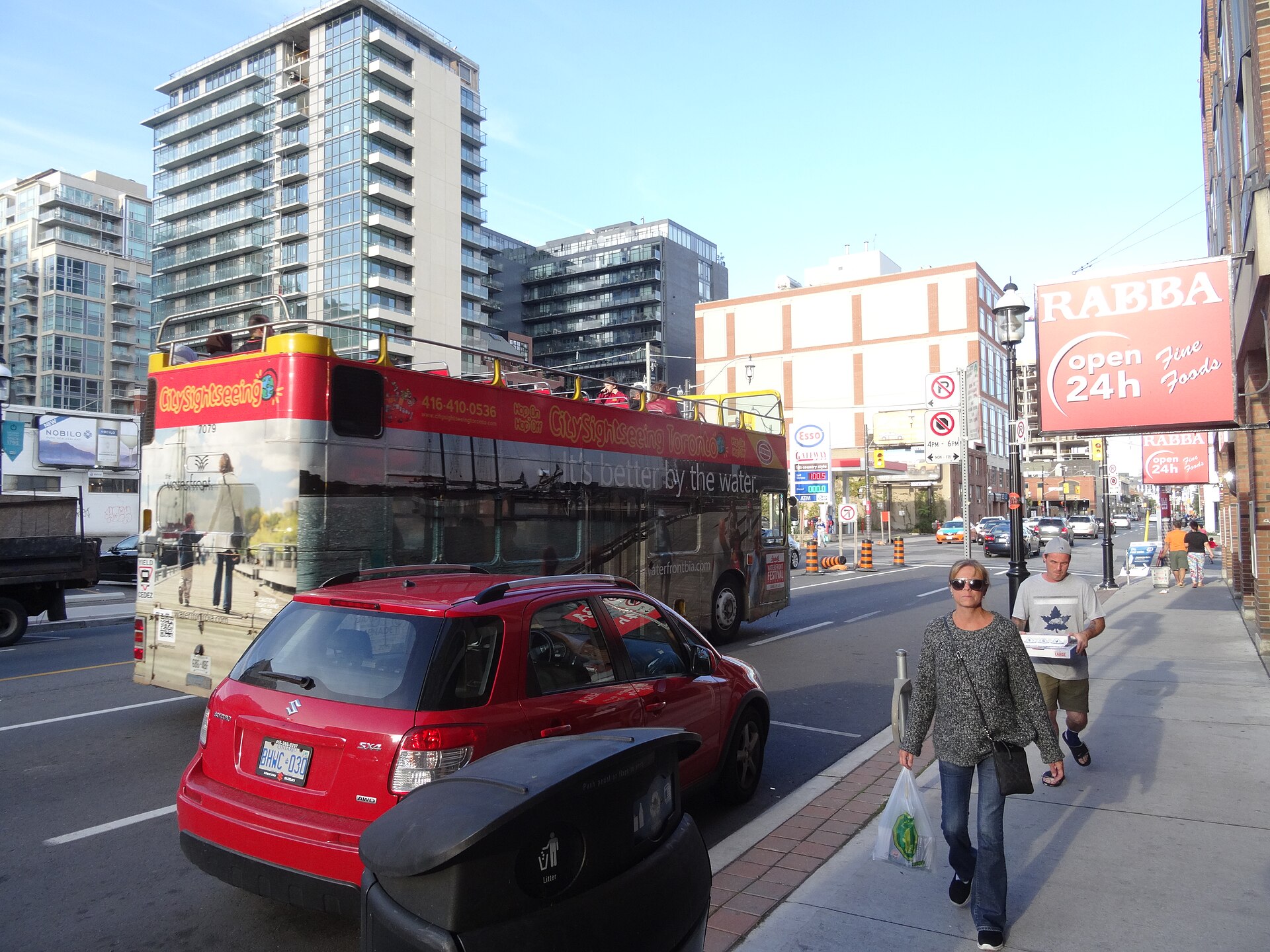
A sightseeing double-decker on Front Street: Double decker tour bus, modeled after a London bus, proceeding east on Front, near Sherbourne, 2015 09 22 (1) by booledozer, Public domain, via Wikimedia Commons.
A sightseeing bus stop sign downtown: Sightseeing bus stop by shankar s. from Dubai, united arab emirates, CC BY 2.0, via Wikimedia Commons.
The same bus pulling away on Front Street: Double decker tour bus, modeled after a London bus, proceeding east on Front, near Sherbourne, 2015 09 22 (2) by booledozer, Public domain, via Wikimedia Commons.