Toronto beaches surprise visitors who didn’t know Lake Ontario could feel like an ocean: 11 designated public beaches stretch across 56 km of waterfront, eight have earned Blue Flag status (the international gold standard for water quality and beach management), and four are car-free island paradises a 15-minute ferry ride from downtown. The water reaches a swimmable 22°C by mid-July, the Toronto Islands beaches face Lake Ontario’s open horizon, and the city posts daily water-quality results so you always know which beaches are safe for swimming. This guide ranks all 11 Toronto beaches by what they’re best for — swimming, families, dogs, sunset, surfing, dunes — and walks through transit, parking, washrooms, and seasonal hours.
Why Toronto beaches deserve more attention
Toronto’s beaches are a sleeper attraction: most visitors don’t realize Lake Ontario has 1,146 km of shoreline and that Toronto’s stretch is among its most varied. The lake is large enough that the south horizon is open water (rather than seeing the U.S. shore — the lake is 85 km wide here), the surf can build to 1–2 metres on windy days, and the water has been steadily improving in quality since the 1990s. Eight of Toronto’s beaches now meet the strict Blue Flag water-quality criteria — the same designation given to top beaches in Greece, Spain, and Australia.
The city tests water at every public beach daily during the summer (June–early September) and posts results at toronto.ca/swimming. A green flag means the water is safe; a red flag means E. coli levels exceed swimming-safe thresholds (usually after heavy rain — bacteria runoff peaks 24–48 hours after a storm).
1. Hanlan’s Point Beach (Toronto Islands)
Hanlan’s Point on the western tip of the Toronto Islands is the city’s most beautiful Toronto beach — a wide, white sand crescent facing Lake Ontario’s open horizon, with the Toronto skyline visible to the east. The eastern half is the only legally designated clothing-optional beach in Ontario (one of just three in Canada). Excellent water quality (Blue Flag), good swimming with sandbars, and a quieter atmosphere than the busier Centre Island beach. Take the Hanlan’s Point ferry from the Jack Layton Ferry Terminal (foot of Bay Street). See our Toronto Islands guide.
2. Ward’s Island Beach (Toronto Islands)
Ward’s Island Beach on the eastern tip of the Toronto Islands is the family beach — a quieter, narrower stretch of sand with the residential cottage community immediately behind. Excellent water quality (Blue Flag), gentle waves, and the small Ward’s Island restaurant a 5-minute walk inland. Take the Ward’s Island ferry; the beach is a 10-minute walk from the dock.
3. Centre Island Beach (Toronto Islands)
Centre Island Beach is the busiest of the Toronto beaches because it sits between the family-focused Centreville amusement park and the easiest ferry dock from downtown. It’s wider than Ward’s, narrower than Hanlan’s, and gets the most foot traffic on summer weekends. Lifeguards are on duty mid-June through Labour Day. The Pier 6 restaurant on the boardwalk is decent for a beach lunch.

4. Woodbine Beach (the Beaches neighbourhood)
Woodbine Beach is the largest mainland Toronto beach — a 1.5 km long, 100-metre wide expanse of sand at the foot of Coxwell Avenue. Eight beach volleyball courts (Toronto’s outdoor volleyball capital), a heated outdoor swimming pool (Donald D. Summerville Olympic Pool), and the boardwalk (3 km of waterfront promenade running west to Ashbridges Bay). Excellent water quality (Blue Flag) and consistent lifeguard coverage. Closest TTC: Woodbine (Line 2) plus 5-minute walk south.
5. Kew Beach
Kew Beach (continuous with Woodbine, just to the west) is the centre of the Beaches neighbourhood — narrower than Woodbine, with the Kew Park gazebo and the popular Beaches Sandcastle Festival each August. The boardwalk passes directly behind the beach and is one of Toronto’s best sunset walks. Closest TTC: 501 Queen streetcar from Yonge.
6. Cherry Beach
Cherry Beach (1 Cherry St, Port Lands) is the closest mainland Toronto beach to downtown — a 15-minute drive from Yonge-Dundas. Excellent water quality (Blue Flag), a popular off-leash dog beach on the east side (2.5 hectares of fenced dog beach with lake access), and a pretty paved bike-and-walking trail along the shore. The kite surfers and wing foilers congregate here on windy afternoons. Limited TTC service — the 72 bus from Pape station is the only direct route.
7. Sunnyside Beach
Sunnyside Beach (1755 Lake Shore Blvd W) sits between High Park and the lake at the western end of downtown. The Sunnyside Pavilion (1922) is one of Toronto’s most photographed Art Deco buildings and houses a popular outdoor café. The waterfront’s freshwater pool — the Gus Ryder Sunnyside Pool — is the city’s best outdoor pool. Less crowded than the Beaches neighbourhood Toronto beaches; better for picnics than for swimming because the water is sometimes flagged due to runoff from nearby creeks.
8. Bluffer’s Park Beach (Scarborough Bluffs)
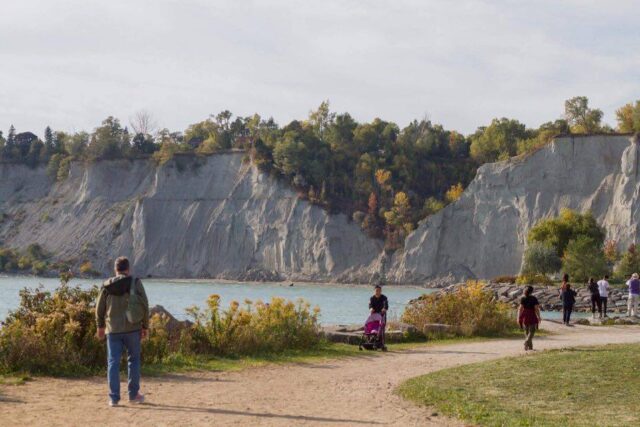
Bluffer’s Park Beach (650 Brimley Rd S) is the most dramatic of the Toronto beaches — a sandy crescent at the base of the 90-metre Scarborough Bluffs cliffs, accessible by a single switchback road down. The cliff faces are a designated Environmentally Significant Area and the swimming area is sheltered by a small marina. Blue Flag status, parking $7.50/day. Only practical via car or a long walk down from Cathedral Bluffs Park.
9. Marie Curtis Park Beach
Marie Curtis Park (2 Forty Second St, near the Toronto-Mississauga border) is the westernmost Toronto beach and the closest beach to Pearson Airport. Sandy beach, river outlet (the Etobicoke Creek), parking, washrooms, and one of the city’s nicest waterfront playgrounds. Less crowded than the Beaches.
10. Rouge Beach
Rouge Beach (Lawrence and Rouge Hills, near Highland Creek) is the quietest of the Toronto beaches — sand-and-pebble, located inside Rouge National Urban Park, with the Rouge River meeting Lake Ontario at its eastern end. Excellent for solitude, beachcombing, and birdwatching. Limited services (no lifeguards). See our Rouge National Urban Park guide.
11. Hanlan’s, Centre, Ward’s: Toronto Islands trio
The three Toronto Islands beaches together form 4 km of continuous shoreline and can all be visited in a single day — start at Hanlan’s Point on the morning ferry (8am, fewer crowds), bike the 4 km Multi-Use Trail east to Centre Island for lunch, then continue another 2 km east to Ward’s Island for the afternoon. The 4pm Ward’s Island ferry back is the quietest crossing.
Practical tips for Toronto beaches
Water temperature and season
Lake Ontario is cold in spring (10–14°C in May, 14–18°C in June), warms quickly in July (20–22°C average), peaks in August (22–24°C average, 25°C+ on warm days), and cools in September (18–20°C). Most Toronto beaches have lifeguards from late June through Labour Day weekend; outside of that window, swim at your own risk.
Water quality and safety
Always check toronto.ca/swimming before swimming. Avoid swimming for 24–48 hours after heavy rain (E. coli runoff peaks). Cherry Beach, Hanlan’s, Ward’s, and Woodbine are the most reliably “green” beaches throughout the summer.
Costs and parking
All Toronto beaches are free to access. Parking lots: Bluffer’s Park $7.50/day, Cherry Beach $4/hour, Woodbine free street parking, Sunnyside metered $4/hour. Toronto Islands ferry: $9.57 adult return, $4.51 for children aged 2 to 14.
What to bring
Sunscreen (Lake Ontario reflects intensely), a beach umbrella (limited shade outside the boardwalks), a refillable water bottle, and cash for the boardwalk food trucks.
The one with the setting that beats all the others is at the bottom of a cliff. Bluffer’s Park Beach sits beneath ninety metres of white sand bluff, supervised in summer with lifeguards and washrooms, and reachable without a car on the seasonal 201 bus from Kennedy station. The water runs colder than the eastern Beaches and the car park fills by mid-morning — our Scarborough Bluffs guide has the timing and the access details.
Plan the rest of your Toronto summer
Beach days pair well with the rest of our Toronto outdoor activities — trails, paddling and park picnics all within transit reach. Pair beach days with the rest of Toronto’s outdoors: Toronto Islands guide, the city’s parks, hiking trails Toronto, kayaking Toronto, top things to do in Toronto, and Rouge National Urban Park. For the post-beach dinner, our Leslieville and the Beaches neighbourhood guide covers all the great spots within walking distance of Woodbine and Kew.
Toronto beaches are clean, free, and easy to reach by transit — pack a swimsuit and pick whichever fits the day’s weather and your taste for crowds.